
The African National Congress has approached the Constitutional Court to challenge the exclusion of 181 of its candidates from the 4 November local government elections, taking a dispute over electronic nominations to the country’s highest court before the ballot is finally beyond correction.11
The party’s application follows the Electoral Court’s dismissal of its earlier challenge against the Electoral Commission of South Africa.
For the ANC, however, the matter cannot end with a software instruction.
The party maintains that its candidates’ details were captured on the IEC’s Online Candidate Nomination System before the 17H00 deadline on 28 August. Required information was loaded, supporting documents were uploaded and the candidates were processed through the party’s own provincial and national verification procedures.
Yet in six municipalities, the nominations were treated as incomplete because the system did not register the final “submit as final” confirmation.
The ANC says that confirmation function is not prescribed in the Municipal Electoral Act, the relevant regulations or the election timetable. It argues that the Electoral Court elevated an internal feature of an electronic platform above the substantive requirements set by electoral law.
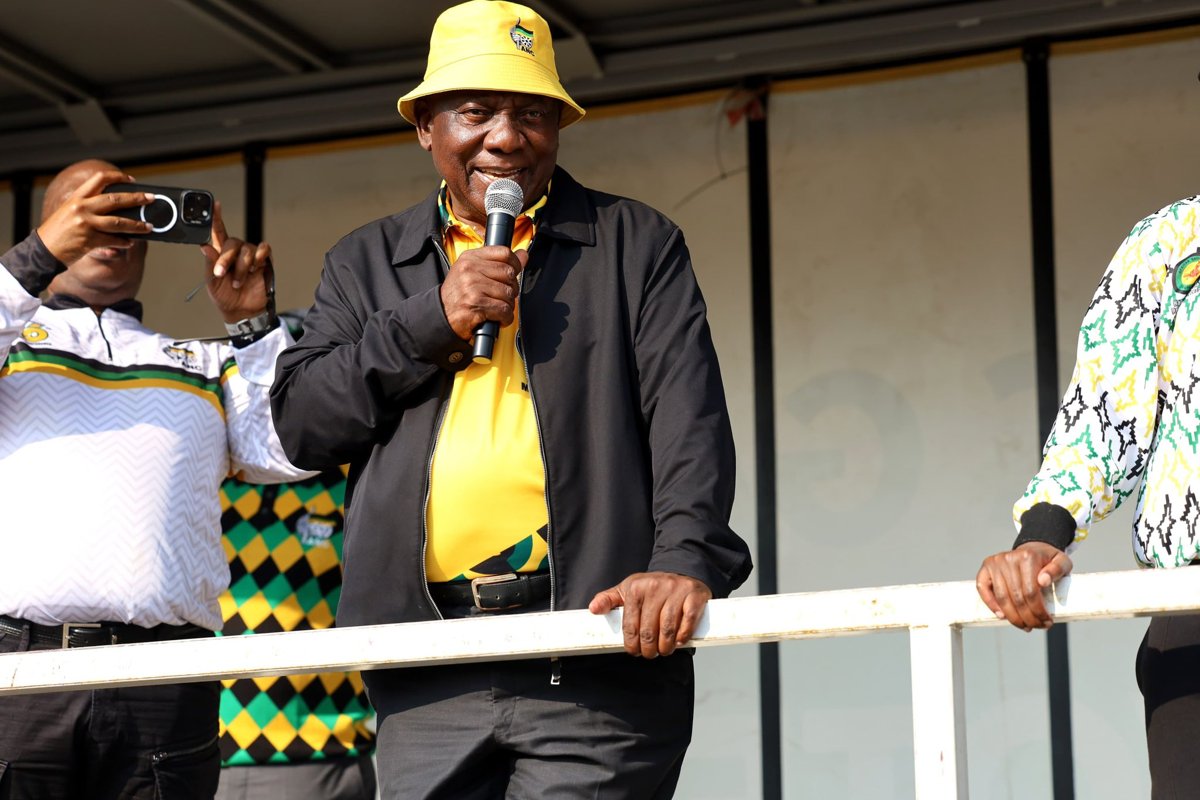
Secretary-General Fikile Mbalula says the party’s case is not a plea for indulgence.
“We are not in court because we are asking for a favour because we missed the deadline,” Mbalula said when the dispute first reached the Electoral Court. “We are not in court because IDs were rejected by the system and we want to load them.”12
The ANC’s position is that candidate information was already in the system before the deadline and that the outstanding issue is whether the failure of a final electronic confirmation can lawfully cancel a nomination that had already been completed in substance.


The six municipalities
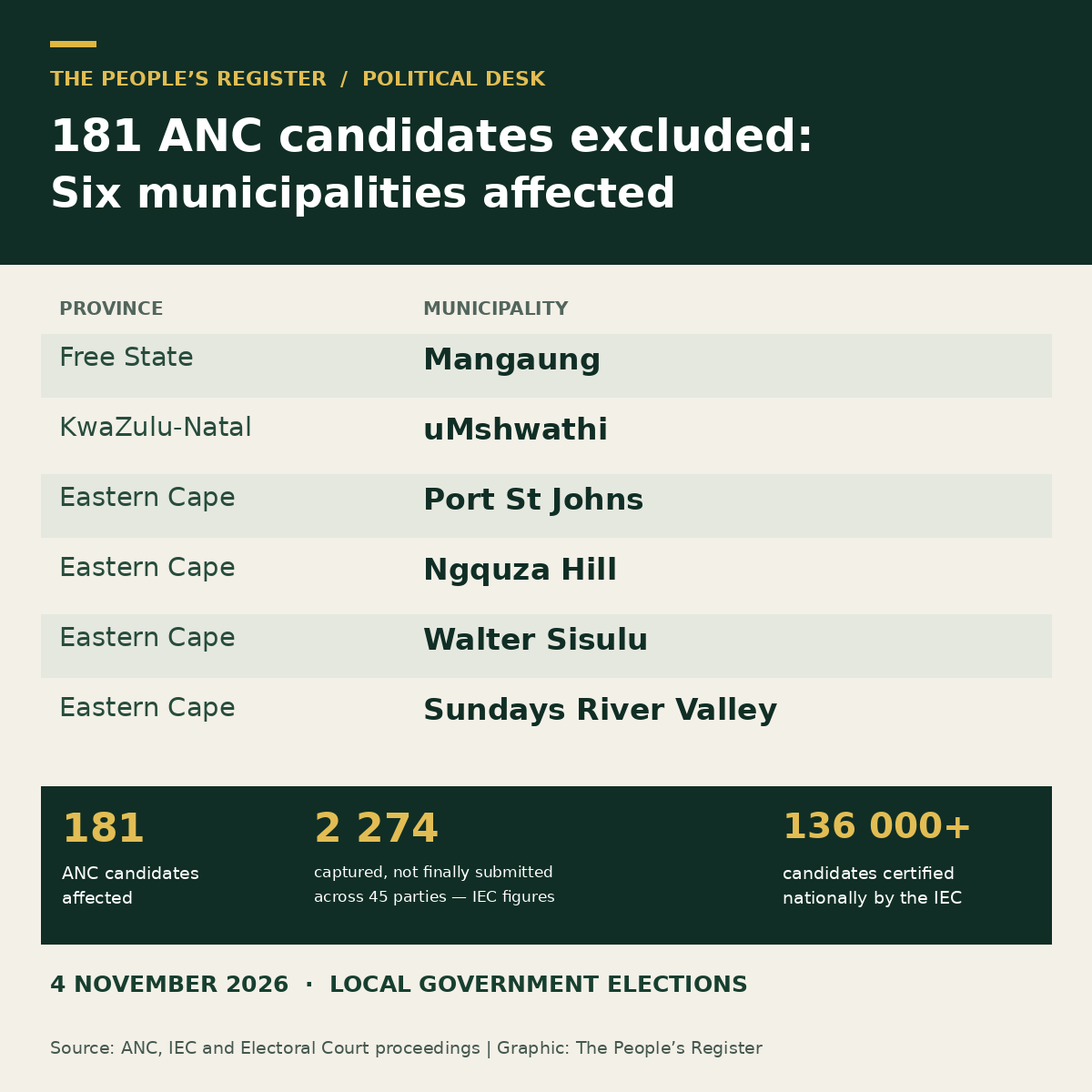
The exclusion affects ANC candidates in Mangaung, uMshwathi, Port St Johns, Ngquza Hill, Walter Sisulu and Sundays River Valley.
The consequences differ across the six municipalities, but the political effect is the same: voters in the affected areas may find an election ballot that does not contain the full ANC field that went through the party’s candidate-selection process.
The 181 candidates comprise 130 proportional-representation candidates and 51 ward candidates.3
The ANC says this is not a matter of trying to add late names to its lists. It says the candidates had already been selected through its internal processes, verified by provincial structures and captured on the IEC’s electronic platform before nominations closed.
Mbalula says the information was loaded by ANC data capturers under the supervision of provincial secretaries and provincial list committees.
The party says the problem arose in the final hour before the deadline, when officials handling the affected lists were locked out of the IEC system and confirmation messages stopped coming through.4
That is the factual dispute the Constitutional Court is now being asked to consider.
The IEC disputes that its system failed and maintains that the affected candidates were captured but not finally submitted.
This is not about special treatment
The ANC has repeatedly stated that it is not asking the courts to suspend the electoral timetable, extend nominations or create an exemption for one party.
It is asking a narrower question.
When candidate information has been captured on the official system before the deadline, and when the candidates have been selected and approved through the party’s own procedures, does a final electronic confirmation become a legal requirement if it is not expressly required by the statute, regulations or timetable?
That distinction is the heart of the case.
The ANC’s concern is that an electronic system may be permitted to create a barrier that has no direct foundation in the law. If a “submit as final” function is indispensable, the party argues, it must be clearly established in the instruments governing the election, not only in the software interface or system guidance.
Mbalula has described the exclusion as disenfranchisement.
“Politically, we have to stand up for this because it is disenfranchisement,” he said.5
The argument is not confined to the ANC’s candidates.
It concerns the communities that will vote in the affected municipalities. A voter in Mangaung, uMshwathi, Port St Johns, Ngquza Hill, Walter Sisulu or Sundays River Valley should not face a reduced choice because an electronic system treated completed nomination data as invisible at the final stage.
A wider electronic-system problem
The ANC’s case has wider implications because it is not alone in raising concerns about candidate-list omissions.
The IEC has acknowledged that 2 274 candidates from 45 political parties were captured on its system but were not finally submitted before the nomination deadline.
The ANC’s 181 candidates are part of that broader group.
The United Democratic Movement has its own dispute with the IEC concerning candidate omissions in Buffalo City. The party’s mayoral candidate, Nqabayomzi Kwankwa, appears on the proportional-representation list, but its ward candidates were not included on the certified candidate list.67
The UDM has indicated that it intends to seek admission as a friend of the court in the ANC’s Constitutional Court matter.
That intervention would be significant. It would demonstrate that the dispute is not simply an ANC administrative difficulty but a wider question about the operation of electronic nomination systems, the clarity of the rules and the respective responsibilities of political parties and the electoral authority.
An election system must require discipline from parties.
It must also provide certainty to parties that have captured their candidates, uploaded their documents and completed the substantive information required before the deadline.
The Electoral Court ruling
The Electoral Court found in favour of the IEC and dismissed the ANC’s appeal.
It accepted the Commission’s position that the finalisation of the nomination on the electronic system was an essential part of submission.
The court’s ruling remains binding unless overturned.
The ANC is not ignoring that ruling. It is using the constitutional route available to it, arguing that the case raises questions of constitutional importance: the right to stand for public office, the right of citizens to vote for candidates of their choice and the requirement that elections be free and fair.
This is not an attack on the IEC as an institution.
Mbalula has previously said the ANC’s disagreement is with the Commission’s legal interpretation, not its constitutional role.
“The ANC is not attacking the Electoral Commission. The ANC disagrees with the Commission on a point of law, and it has taken that disagreement to the court that Parliament has created to hear it,” he said.8
The ANC is asking the Constitutional Court to decide whether the Electoral Court correctly interpreted the law and whether the effect of the electronic nomination process is consistent with constitutional electoral rights.
The IEC’s position
The IEC has certified more than 136 000 candidates to contest the local government elections.
Its concern is that the election timetable must remain certain and that candidate lists have to be finalised in time for ballot preparation, printing and election administration.910
Those practical requirements are real.
An election of this scale cannot operate without deadlines. The IEC must produce ballots, administer voting stations, ensure that candidate information is accurate and provide all parties with equal treatment.
But the ANC’s application does not ask the Constitutional Court to abolish deadlines.
It asks the court to decide whether a deadline was met when all substantive nomination information was captured before the cut-off and only a final electronic status was not recorded.
That is a distinction with consequences far beyond the present matter.
Technology is meant to assist democracy, not introduce hidden thresholds that narrow participation without clear legal authority.
The DA’s expected opposition
The Democratic Alliance intervened in the Electoral Court matter and is expected to oppose the ANC’s Constitutional Court application.
The DA’s position has been that the final electronic step was mandatory and that allowing the ANC candidates onto the ballot would compromise equal treatment between parties.
The ANC’s response is that equality cannot mean treating a disputed software step as more important than the law, particularly where the affected candidates’ information was already captured before the deadline.
The ANC is not seeking the removal of a DA candidate from any ballot.
It is seeking the restoration of candidates who had already been selected, verified and captured in the IEC system.
The effect of a favourable ruling would be to widen voter choice, not reduce anyone else’s right to contest.
The urgency
The Constitutional Court application is urgent because the local elections are six weeks away.
The ANC is seeking relief before ballot arrangements become irreversible. Every day matters.
Once ballot papers have been printed and the election process has moved past key administrative stages, a remedy becomes more difficult even if the legal argument succeeds.
The ANC is therefore asking the court to hear the matter on an expedited basis.
The party’s argument is that delay itself could become a form of denial.
If the court waits until the election is complete, the candidates will already have been excluded and voters will already have cast ballots without the choices they were entitled to consider.
A matter of principle
The Constitutional Court now faces a question that goes beyond a single button on an online system.
The ANC is asking it to decide whether electoral rights may be curtailed by a software function that the ANC says does not appear in the governing law, or whether candidate nominations captured and documented before the deadline must be assessed according to their substantive compliance.
The party’s case does not deny the importance of administrative order.
It argues that order must serve democracy.
The dispute also underlines the importance of tighter internal submission controls: earlier verification, checked confirmation records and independent confirmation of every final step.
But an organisational lesson does not answer the constitutional question before the court.
The current dispute concerns candidates whose names were already captured, candidates whose documents were already uploaded and communities whose ballots may be narrowed by a technical interpretation of the nomination process.
The ANC has taken the matter to the Constitutional Court because those voters deserve an answer before 4 November.
They deserve to know whether the law protects their right to choose from the full field of candidates, or whether a final click can erase a nomination that had already been completed in every meaningful respect.
The Constitutional Court now has the opportunity to decide.
-
https://www.ewn.co.za/2026/09/09/anc-not-expecting-special-treatment-from-iec-after-failing-to-meet-candidates-list-deadline ↩
-
https://www.ewn.co.za/anc-not-expecting-special-treatment-from-iec-after-failing-to-meet-candidates-list-deadline/ ↩
-
https://iol.co.za/news/politics/2026-09-13-from-candidate-chaos-to-leadership-revolt-mbalula-faces-crucial-anc-test/ ↩
-
https://www.jacarandafm.com/news/news/anc-heads-concourt-exclusion-181-election-candidates/ ↩
-
https://www.enca.com/news-top-stories/anc-takes-181-candidate-battle-concourt ↩
-
https://www.dailydispatch.co.za/news/2026-09-18-udm-heads-to-court-over-buffalo-city-candidate-list-snub/ ↩
-
https://iol.co.za/news/politics/2026-09-20-udm-takes-candidate-list-fight-to-court-as-buffalo-city-ward-candidates-remain-off-iec-list/ ↩
-
https://www.ewn.co.za/anc-explains-decision-to-approach-electoral-court-over-candidates-list-debacle-with-iec/ ↩
-
https://www.dailymaverick.co.za/article/2026-09-16-iec-finalises-ballot-while-anc-faces-exclusion-in-six-municipalities/ ↩
-
https://iol.co.za/news/politics/2026-09-16-more-than-136000-candidates-cleared-to-contest-november-local-government-elections/ ↩
-
https://www.ewn.co.za/2026/09/23/anc-s-fight-to-have-181-candidates-included-in-nov-polls-heading-to-concourt ↩