
News Analysis · World · Cuba and multilateralism
South Africa backs ending Cuba embargo as UN majority narrows
The UN’s 130–17 vote preserves a majority against the embargo but changes no US law. Civilian hardship remains central to Pretoria’s call for dialogue.
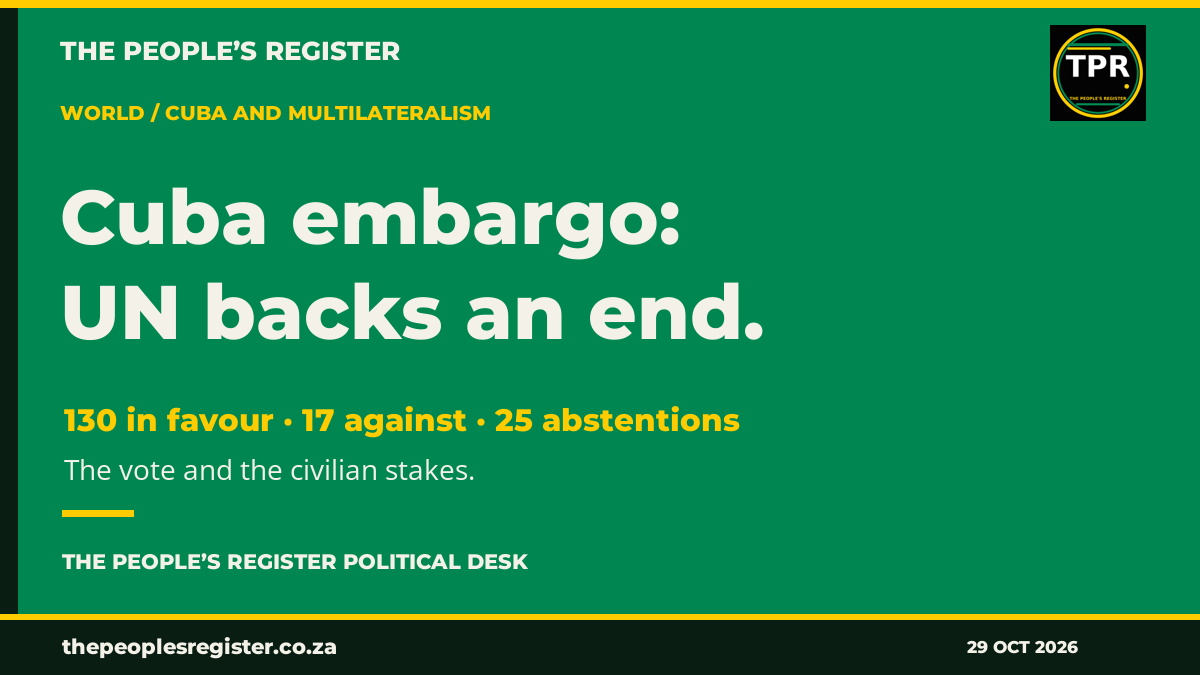
South Africa backed the United Nations General Assembly’s latest call to end the United States embargo on Cuba on Wednesday, 28 October 2026. The resolution passed with 130 votes in favour, 17 against and 25 abstentions. UN meeting coverage (opens in a new tab) confirms the result; SABC’s report (opens in a new tab) records Pretoria’s support.
The result preserves a substantial international majority against the embargo. The non-binding resolution (opens in a new tab) changes no US law and does not itself lift the restrictions. The diplomatic result therefore leaves the practical consequences for Cuban households unresolved.
A narrower majority
The resolution received 165 affirmative votes in 2025, with seven against and 12 abstentions. This year brought 35 fewer votes in favour, alongside increased opposition and abstention. Germany and Italy were among those abstaining, Reuters reported (opens in a new tab).
An abstention remains distinct from a vote against. The changed tally gives Washington a broader diplomatic opening, while the resolution’s adoption preserves Havana’s majority on the question before the Assembly. Both developments matter in assessing the outcome.
Pretoria’s argument for dialogue
South Africa’s envoy, Mxolisi Nkosi, called for renewed Washington–Havana talks, an end to the embargo and additional restrictions, Cuba’s removal from the US state-sponsors-of-terrorism list and suspension of the Helms–Burton Act’s application. SABC reported (opens in a new tab) that he connected those demands to deteriorating health and livelihoods.
The position has an established policy history. In a 5 June 2026 statement (opens in a new tab), South Africa’s Presidency reaffirmed opposition to the embargo and identified health, education, infrastructure and water cooperation among the countries’ shared priorities. Those practical relationships sit alongside their liberation history.
Civilian hardship and government responsibility
The European Union’s 28 October explanation of vote (opens in a new tab) acknowledged the embargo’s adverse humanitarian effects. It described power cuts, shortages of food and medicine and hospitals struggling to function, while also attributing significant responsibility to Cuban economic decisions, structural weaknesses and inadequate investment.
The EU called for political and economic reforms, protection of fundamental freedoms and the release of political prisoners. Its account leaves room to oppose measures that worsen civilian hardship while examining the Cuban authorities’ responsibilities for their own decisions.
US Ambassador Mike Waltz accused Cuba’s leadership of corruption, repression and exploitation, and disputed its description of a blockade, according to UN meeting coverage (opens in a new tab). Cuba’s Foreign Minister Bruno Rodríguez defended the resolution as a response to US measures threatening his country.
From diplomatic backing to material change
South Africa has put dialogue and the removal of restrictions at the centre of its response. That approach must be assessed through its consequences for access to energy, food and healthcare, alongside protection of Cubans’ rights.
The Assembly has reinforced a diplomatic demand. Translating that support into policy changes and better living conditions remains the work ahead; the vote itself delivers neither.
Sources and further reading
- United Nations meeting coverage: adoption of Cuba embargo resolution, 28 October 2026 (opens in a new tab)
- SABC: South Africa’s support and diplomatic demands, 28 October 2026 (opens in a new tab)
- Reuters: vote comparison, changed positions and legal effect, 28 October 2026 (opens in a new tab)
- European Union: explanation of vote, 28 October 2026 (opens in a new tab)
- South African Presidency: Cuba relationship and opposition to embargo, 5 June 2026 (opens in a new tab)