
Politics · Brazil election · News analysis
Lula’s victory shows the far right can be defeated
Lula’s re-election protects a progressive government and an independent voice for the Global South. For South Africa’s liberation movement, the result is a reason for solidarity and a challenge to make democratic government deliver.
THE PEOPLE’S REGISTER
BRAZIL / NEWS ANALYSIS
Lula wins.
The far right can be defeated.
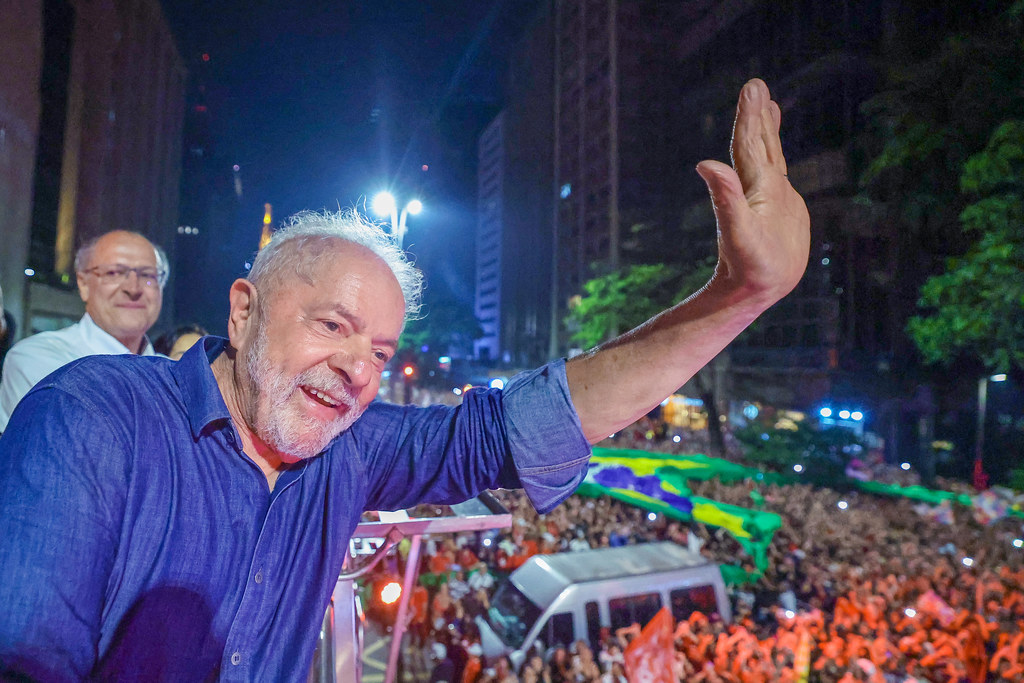
Luiz Inácio Lula da Silva’s re-election has delivered a significant setback to Brazil’s far right and its allies in Donald Trump’s political orbit. The Workers’ Party incumbent defeated Senator Flávio Bolsonaro, son of former president Jair Bolsonaro, in Sunday’s runoff to secure a fourth presidential term. Associated Press reported a completed count of approximately 51.8% for Lula against 48.2% for Bolsonaro, a margin approaching 4.4 million votes.
The victory reverses the first-round result on 4 October, when Flávio Bolsonaro finished ahead with 47.03% against Lula’s 45.16%. A right-wing advantage that had shaken the Brazilian left was overcome in three weeks.
Brazil cannot speak for the entire world. Its electorate has, however, challenged the assumption that the far right’s advance is inevitable. For progressive movements watching from South Africa, the significance reaches beyond the defeat of one candidate.
A progressive record people could measure
Lula entered this election with a record that could be assessed in people’s daily lives.
In June 2023, he signed the redesigned Bolsa Família programme into law, guaranteeing eligible families a minimum monthly payment of 600 Brazilian reais, with additional support for children and pregnant women. Social protection remained an explicit responsibility of the state.
Government reporting of national statistics agency IBGE’s findings put poverty at 23.1% in 2024, down from 27.3% in 2023. Employment, earnings and social transfers contributed to that improvement. The gains reflect interacting economic conditions and public policies, with working people’s incomes central to the explanation.
The UN Food and Agriculture Organization confirmed in July 2025 that Brazil had again left its Hunger Map, meaning estimated undernourishment had fallen below 2.5%. Hunger had not disappeared. The change nevertheless recorded a substantial advance in a country where food insecurity has carried enormous human and political consequences.
This record gives the progressive argument material substance. Democratic politics must offer a credible answer to insecurity. Defending institutions becomes more persuasive when people can connect that defence to food, income and the prospect of a more stable life.
Organisation after the first-round shock
The campaign between the two rounds supplied another important part of the story. Associated Press documented renewed street activity and social-media campaigning by the Brazilian left after Bolsonaro’s first-round lead unsettled Lula’s supporters. Activists sought to reach voters and rebuild urgency around the consequences of the runoff.
Further research will be needed to establish how different groups voted and which campaign interventions changed the outcome. The result alone cannot prove that any single organising method delivered victory.
It does reinforce a practical argument for progressive movements: a governing record needs people capable of explaining it, defending its gains and listening to those whom it has failed to reach. Electoral confidence depends on sustained relationships with communities. Past loyalties cannot substitute for that work.
Trump, the Bolsonaro movement and sovereignty
Flávio Bolsonaro’s candidacy represented a distinct international orientation. Reuters reported his friendly relationship with the Trump administration, supported by his brother Eduardo Bolsonaro’s connections in Washington. Trade, strategic minerals and security policy formed part of the stakes surrounding the election. Lula’s emphasis on multilateral cooperation and the Global South offered a different direction.
Washington’s willingness to apply political pressure was already documented. In July 2025, the White House explicitly connected an additional tariff against Brazil to Jair Bolsonaro’s prosecution and Brazilian regulation of technology platforms. Those were the US administration’s stated justifications and accusations.
The significance of Lula’s victory therefore extends to who sets Brazil’s priorities. It preserves space for the country to pursue an independent foreign policy and negotiate its economic relationships through a government chosen by its electorate. Brazilians’ right to determine their political future carries particular weight for liberation movements whose own histories were shaped by external domination.
Democratic access, and the evidence still required
The election also raised serious questions about access to voters and access to the ballot.
Lula’s coalition accused Meta of favouring Bolsonaro and restricting pro-Lula content. Brazil’s electoral authorities ordered explanations while stressing that the available evidence had not established the alleged irregularities. Meta denied political interference and attributed disruptions to technical errors. The allegations require scrutiny; deliberate manipulation has not been established by those proceedings.
Transport complaints also prompted Supreme Federal Court justice Cristiano Zanin to order voting extended until 19:00 Brasília time. Electoral authorities subsequently clarified that voting could continue on machines that remained open. The order should be distinguished from a finding that every reported transport disruption was an intentional act of suppression.
The underlying democratic issue reaches beyond Brazil. A formal right to vote depends on practical access. Transport, reliable information and functioning polling arrangements are part of participation itself.
What solidarity means for South Africa
The ANC’s relationship with Lula and the Workers’ Party has a documented political history. Its November 2022 National Executive Committee statement welcomed Lula’s election and associated his return with stronger progressive voices in BRICS. An August 2023 advisory recorded continuing political ties between the two parties.
During his March 2026 visit to Brazil, President Cyril Ramaphosa recalled Brazilian solidarity with South Africa’s liberation struggle and linked the countries’ partnership to equality, development and the eradication of poverty. These statements establish the relationship; they are not a new ANC response to this election.
From that internationalist perspective, Lula’s renewed mandate provides grounds for solidarity and renewed cooperation. It also poses a demanding question for the ANC and its allies: how do progressive movements translate their history, organisation and control of government into improvements that people can experience?
Brazil’s outcome does not remove the obstacles. Congress shifted further right, leaving substantial opposition power beyond the presidency. The Bolsonaro movement remains a political force, and Lula must sustain social gains while governing through difficult institutional conditions.
The Brazilian electorate has shown that the far right can be defeated. The responsibility that follows is to make democratic government deliver enough to sustain the confidence that defeated it.
Sources and further reading
- Associated Press: completed runoff count, 26 October 2026
- Agência Senado: runoff victory and first-round figures, 25 October 2026
- Brazilian social development ministry: Bolsa Família law, 20 June 2023
- Brazilian social development ministry: IBGE poverty findings, December 2025
- FAO: 2025 food security report launch, 28 July 2025
- Associated Press: left-wing street and social-media mobilisation, 23 October 2026
- Reuters: US trade, strategic minerals and the candidates’ foreign policies, 9 October 2026
- White House: stated political rationale for its Brazil tariff, 30 July 2025
- TSE: inquiry into alleged unequal platform treatment, 23 October 2026
- Meta: denial and explanation of technical errors, 16 October, updated 18 October 2026
- Agência Brasil: Justice Zanin’s voting-extension order, 25 October 2026
- Agência Brasil: clarification on machines still open, 25 October 2026
- ANC: NEC statement welcoming Lula’s 2022 election, 14 November 2022
- ANC: national officials’ meeting with Lula, 22 August 2023
- President Ramaphosa: Brazil state-visit remarks, 9 March 2026
- Associated Press: Congress’s shift to the right, 22 October 2026