
Public Information · Fuel prices · Cost of living
Petrol falls just 1c as diesel drops and paraffin rises from 4 November
The final adjustment shows how levy relief and other costs combine. Our guide separates petrol pump prices, diesel wholesale changes and household cooking-fuel costs.
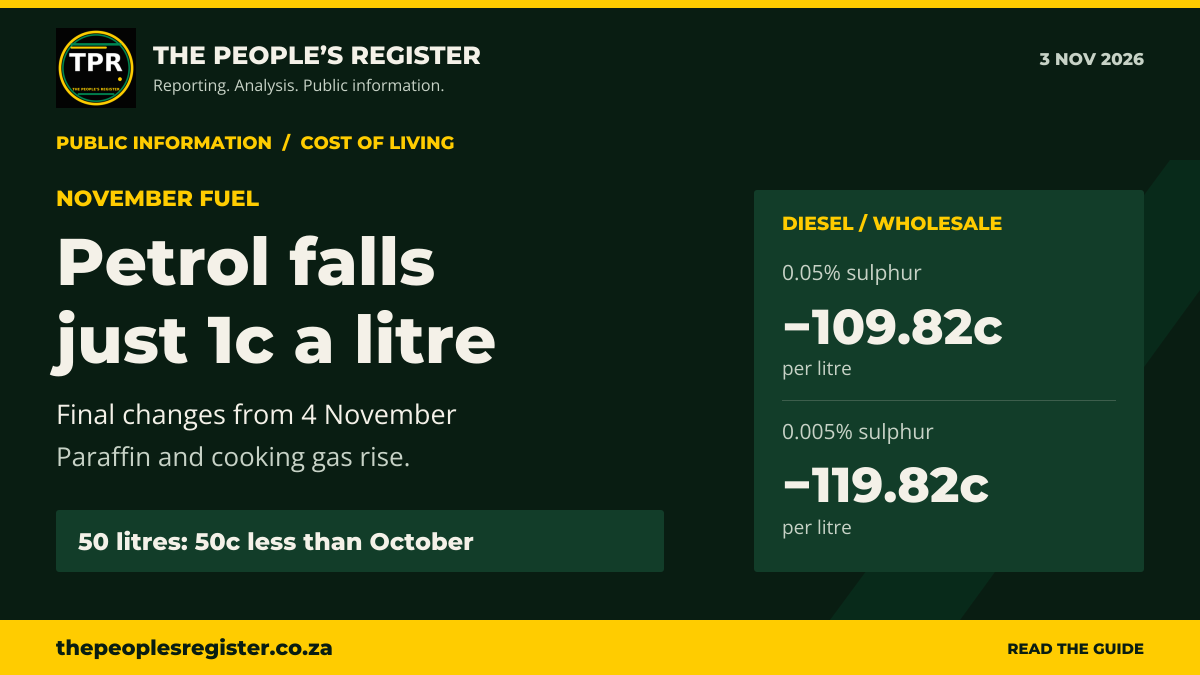
Petrol will fall by just one cent a litre from Wednesday, 4 November, while diesel becomes cheaper and paraffin and cooking gas become more expensive.
The final changes announced by Mineral and Petroleum Resources Minister Gwede Mantashe show why a reduction in the fuel levy does not translate into an identical reduction at the pump.
The changes from 4 November
| Product | Change |
|---|---|
| Petrol 93 and 95 | Down 1c per litre |
| Diesel 0.05% sulphur, wholesale | Down 109.82c per litre |
| Diesel 0.005% sulphur, wholesale | Down 119.82c per litre |
| Illuminating paraffin, wholesale | Up R2.75 per litre |
| Paraffin, single maximum national retail price | Up R3.66 per litre |
| LPG, maximum retail price | Up R1.83 per kilogram, or R2.08 in the Western Cape |
Where the levy relief goes
SARS's tariff amendments reduce the general fuel levy on petrol from R4.10 to R2.60 a litre, and on diesel from R3.93 to 93c. These figures exclude the separate carbon fuel levy. The reductions apply from 4 November through 1 December.
That removes R1.50 from the petrol levy and R3 from the diesel levy. Other parts of the price calculation have moved upwards. The department reports higher international petroleum-product prices and a weaker average rand during the review period.
The department's pricing explanation sets out the wider calculation: imported-product costs, the exchange rate, taxes, margins, transport and other charges all contribute. A cut to one component can cushion an increase elsewhere while producing a much smaller change in the final bill.
What that means for a 50-litre fill
For a motorist buying 50 litres of petrol, a 1c-per-litre decrease means paying 50c less than for the same quantity at the applicable October price. The calculation is 50 litres multiplied by R0.01.
The levy reduction alone amounts to R75 on that quantity, calculated as 50 multiplied by R1.50. That R75 describes the tax component removed from November's price build-up. It should not be presented as the month-to-month saving on a tank.
Diesel needs a further distinction. The department regulates petrol retail prices but publishes a wholesale list price for diesel, whose retail price is not regulated. The two diesel figures in the table therefore describe wholesale changes. A driver should check the actual price offered by the filling station.
Cooking fuel puts a different pressure on households
For a household purchasing 10 litres of paraffin at the national retail ceiling, the increase in that ceiling adds R36.60 to the maximum fuel bill. Buying below the ceiling would produce a different bill.
Similarly, multiplying the LPG adjustment by nine gives an increase of R16.47 in the maximum price for nine kilograms of gas, or R18.72 in the Western Cape. These are illustrations of the fuel-price change alone, excluding any separate cylinder or delivery charge.
The relief is temporary
In his 21 October budget statement, Finance Minister Enoch Godongwana announced smaller levy reductions after 1 December: R1 a litre for petrol and R1.50 for diesel, continuing until 5 January 2027. He put the total revenue cost at R10 billion, funded by money returned from the Central Energy Fund.
Those are the announced tax arrangements. Future monthly prices will still depend on the other components. TPR's earlier fuel-relief explainer sets out the distinction between an interim cost indicator, a levy decision and the final adjustment.
Sources and further reading
- SAnews: Government announces fuel adjustments · 2026-11-03
- SARS: Tariff amendments, fuel levy notices · 2026-11-03
- DMPR: Fuel price structure · Undated; accessed 2026-11-03
- Finance minister: Medium-Term Budget Policy Statement · 2026-10-21
- SARS: 2026 budget tariff amendments distinguish the general and carbon fuel levies · Effective 2026-04-01