
Africa & world · African industrialisation and development finance
Africa’s industrialisation week asks who will finance factories and local jobs
The programme puts local processing, women’s enterprises and young entrepreneurs on its agenda. Turning those aims into production requires more than investment announcements.

Share-image credit and reuse
Share card: the same photograph resized without cropping or retouching, with TPR headline and branding added. Photo adaptation: CC BY-SA 4.0 (opens in a new tab).
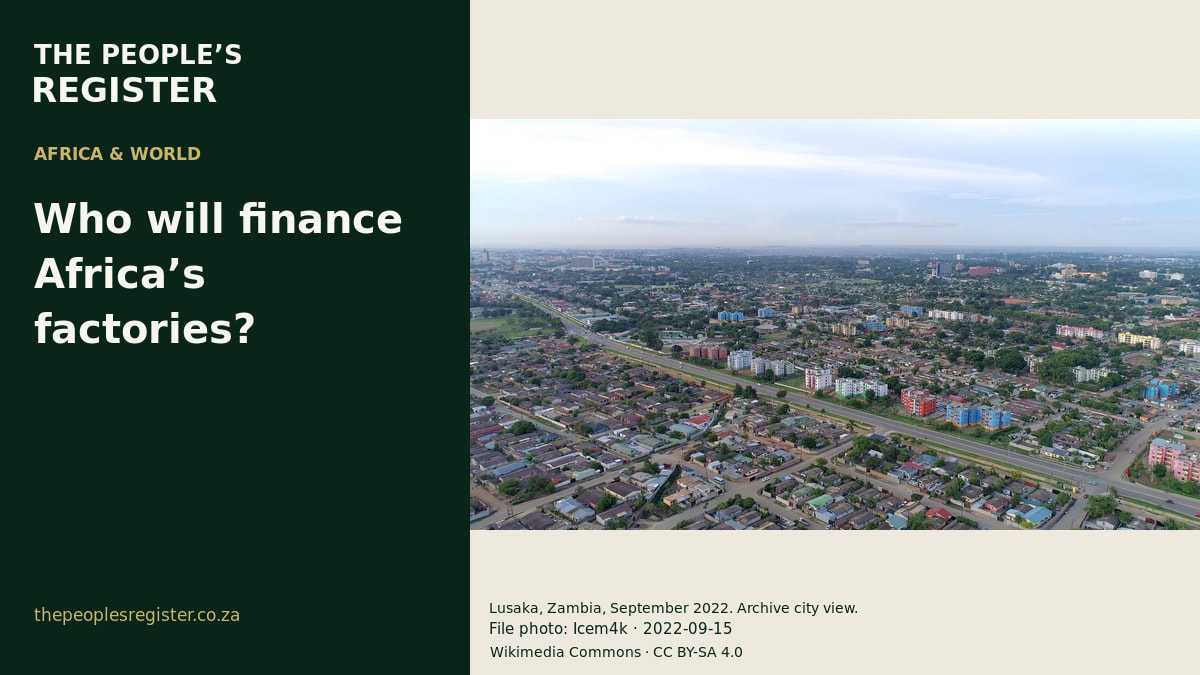
Africa Industrialisation Week’s 17–20 November programme in Lusaka places a direct question before governments and financiers: how will the continent pay to expand production? The African Union’s programme (opens in a new tab) links finance to processing raw materials locally, regional supply chains and access for women and young entrepreneurs. These are stated priorities, not completed investments.
The meeting includes an African Women in Processing forum and seeks commitments from public and private financiers. Its proposed outcomes include financing arrangements and improved access for smaller firms. The next test is whether any resulting agreements identify real projects, funding terms and the institutions responsible for delivery.
The scale of the manufacturing gap
The UN Industrial Development Organization’s 2025 Africa factsheet (opens in a new tab) puts the continent’s share of global manufacturing value added at 2.0% in 2024, compared with 3.2% of global GDP. It describes a manufacturing structure still concentrated in lower-technology activities. These are 2024 measurements, useful as context for this week’s debate rather than a reading of current factory output.
This gap is about where value is created and retained. Selling a raw input leaves other stages of production elsewhere. Processing it locally can create opportunities for engineering, maintenance, transport and supplier firms, but only if the new activity is viable and its benefits extend beyond the ownership of one plant. Jobs, wages and local purchases should be visible in any assessment of success.
The broader policy framework has already moved. In May, the UN General Assembly proclaimed the Fourth Industrial Development Decade for Africa, 2026–2035 (opens in a new tab). UNIDO says its implementation is expected to work through industrial corridors, regional manufacturing networks and investment projects. The declaration establishes an organising framework; it does not itself finance a factory.
Follow the terms, then the results
For a small manufacturer, the practical questions concern the cost and duration of finance, reliable energy, access to customers and the ability to meet production standards. A short repayment period may be a poor fit for equipment that takes time to install and earn income. A cheaper loan cannot by itself solve an unreliable supply of electricity.
Public institutions should also explain who carries the downside when projects receive guarantees or subsidised finance. If the public takes on risk, the public should be able to see the promised benefits and whether they arrive. That means reporting local employment and training, procurement from smaller suppliers and the environmental costs borne by surrounding communities.
Regional integration gives this agenda a wider purpose: producers need access to markets and complementary suppliers across borders. The measure of the Lusaka discussions will be the agreements that survive after the meeting, followed by plants operating, workers learning valuable skills and African firms doing more of the production themselves.