
Ideas & History
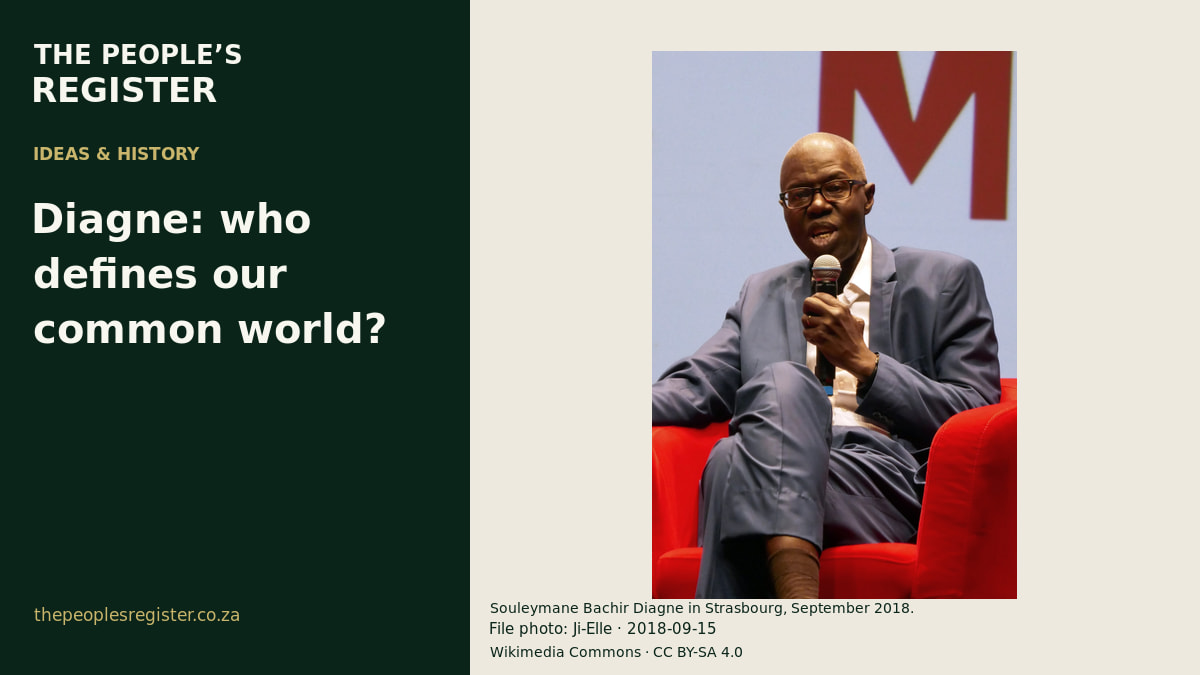
Souleymane Bachir Diagne: a common humanity without an imperial centre
Ahead of World Philosophy Day, the Senegalese philosopher’s account of translation asks who gets to define what is universal.
Understand the past. Question the present. Imagine the future.
Ideas & History
Ahead of World Philosophy Day, the Senegalese philosopher’s account of translation asks who gets to define what is universal.
History from Below
Cabral’s agronomy and political writings reveal why liberation requires accurate social knowledge, correction of error and limits on the authority of its interpreters.
Ideas Explained
Davis’s writing tests punishment against safety, connects public and private violence, and asks what institutions can replace dependence on imprisonment.
Classics Revisited
Fanon’s clinical writing exposes how institutions can misread the people they serve, and why changing the relationship of care requires more than good intentions.
Ideas Explained
Achille Mbembe’s work asks how shared life can become a political commitment. Belonging requires institutions that change unequal protection and power.
Public Scholarship
Bina Agarwal’s group-farming research separates higher output from a harder question: who controls the gains?
From the Archive
Tutu tied reconciliation to material repair. The TRC’s law, recommendations and later government decisions reveal why that obligation remained contested.
Ideas Explained
Cooperation needs enforceable institutions. Elinor Ostrom’s experiments also expose why success and justice must be judged separately.
Public Scholarship
Liberian women helped move a peace process. Leymah Gbowee’s organising raises a harder question: how can their influence survive the settlement?
Ideas Explained
Oil divestment can change ownership without repairing polluted land. Nnimmo Bassey’s argument tests what a just transition must leave behind.
Ideas Explained
Pest control, mathematical simplification and the political choices inside a scientific model.
Classics Revisited
Reading Richard Lewontin alongside modern genetics shows why predicting educational outcomes and explaining how to change them are different scientific tasks.
Public Scholarship
A feminist account of scientific objectivity, tested against the contested interpretation of a classic fruit-fly experiment.
Classics Revisited
From tree nurseries to Karura Forest, Maathai made ecology a struggle over land and power. Keeping a forest public also meant confronting unequal access.
Public Scholarship
KwaZakhele’s solar co-operative tests what collective ownership requires, from democratic control to a workable route from generation to income.
Ideas Explained
Fraser’s account of care tests whether income, public services and working time expand freedom for those who give care as well as those who receive it.
Classics Revisited
Freire’s work distinguishes professional authority from intellectual domination and asks how political education can remain open to disagreement.
Public Scholarship
A close reading of Maharajh’s work asks whether innovation changes the distribution of knowledge, productive capacity and democratic power.
From the Archive
First’s miner research and her account of collective inquiry expose the material and intellectual demands of liberation.
History from Below
A close reading of Biko and Mamphela Ramphele shows why representation requires control over decisions, resources and the terms of political debate.
Classics Revisited
Reading Rodney on racial justice, class organisation and worker control reveals why national ownership and popular power cannot be treated as the same achievement.