
News Analysis · Nelson Mandela Bay · Election analysis
ANC’s competitive base keeps the Bay election contest open
Published polling puts ANC and DA ahead of individual smaller parties. Delivery and accountability remain central to the contest for a mandate.
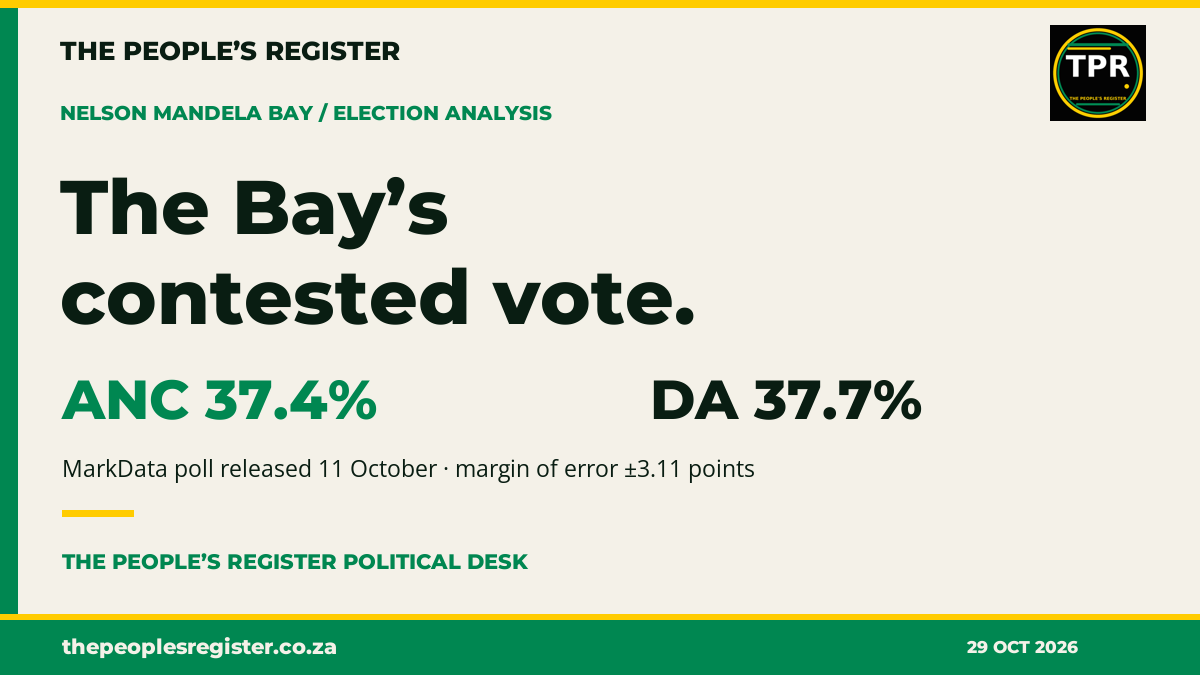
The ANC enters the final six days of the municipal election campaign with a substantial competitive base in Nelson Mandela Bay. The eNCA/MarkData results released on 11 October (opens in a new tab) placed it at 37.4%, alongside the DA’s 37.7%.
For the ANC, that is electoral ground worth organising around. It gives the party an opening to make a serious case for a mandate in a metro where the quality of local government has direct consequences for daily life.
A close contest with an unfinished argument
The survey’s methodology note (opens in a new tab) dates fieldwork to 10 August–14 September. Nelson Mandela Bay had 994 respondents and a reported margin of error of plus or minus 3.11 percentage points at 95% confidence. The 0.3-point gap establishes no clear leader. The figures are a campaign starting point, not a measurement of an October recovery.
The same results carry a warning: in a question about poorly run cities and service failures, 51.1% principally blamed the ANC. Some 58.8% lacked confidence in the mayor and municipality’s ability to resolve water challenges. Support and dissatisfaction coexist in this snapshot.
That combination demands a campaign capable of listening as well as explaining. A resident can retain an attachment to a political movement while expecting a more convincing account of missed repairs, unreliable services or unanswered complaints. The response has to connect responsibility to action.
An effective ANC argument would therefore make delivery commitments that residents can follow: what will be done, who is responsible and when progress will be reported. A promise gains weight when people can return to it after election day.
Support must become governing strength
The published table puts the EFF at 8%, the Patriotic Alliance at 4%, ActionSA at 3.4% and MK at 3.2%. Each individually sits well below the two largest contenders. Smaller parties face a contest for representation and possible influence in a fragmented council. This snapshot provides no basis for claiming a common decline or forecasting a coalition.
The IEC’s account of metropolitan elections (opens in a new tab) explains the two ballots, one for a ward representative and one for proportional party representation. The result will determine each party’s strength in the council, where governing decisions must be made.
For the ANC, mobilisation consequently has two connected purposes: persuading people to support its programme and ensuring that supporters participate. A competitive survey position becomes consequential through ballots, representation and the ability to sustain a working administration.
Accountability after the campaign
The Constitution’s local-government chapter (opens in a new tab) places democratic accountability, sustainable services and community participation among municipal government’s purposes. These are useful tests for any party asking to govern the Bay.
They also give substance to the ANC’s claim to represent communities. Participation should continue through accessible councillors, clear reporting and opportunities to challenge decisions. The political relationship has to survive beyond the campaign visit.
Wednesday, 4 November is election day and a public holiday (opens in a new tab). Voters must use their registered stations.
The ANC has a competitive base from which to work. The stronger case for a renewed mandate will be made by showing how organisation, public resources and accountable leadership can improve the municipality people encounter each day.
Sources and further reading
- eNCA/MarkData: Nelson Mandela Bay results, released 11 October 2026 (opens in a new tab)
- eNCA: dedicated MarkData methodology, 11 October 2026 (opens in a new tab)
- Electoral Commission: how metropolitan municipal elections are contested (opens in a new tab)
- South African Government: Constitution, Chapter 7, Local Government (opens in a new tab)
- The Presidency: election day and public holiday declaration, 15 September 2026 (opens in a new tab)