
News Analysis · Elections 2026 · Nelson Mandela Bay · Municipal government
ANC’s battle for the Bay: a stronger mandate faces a practical governing test
The ANC’s majority argument meets a local programme of repairs, capable administration and economic opportunity. The test is whether residents can follow those commitments into results.
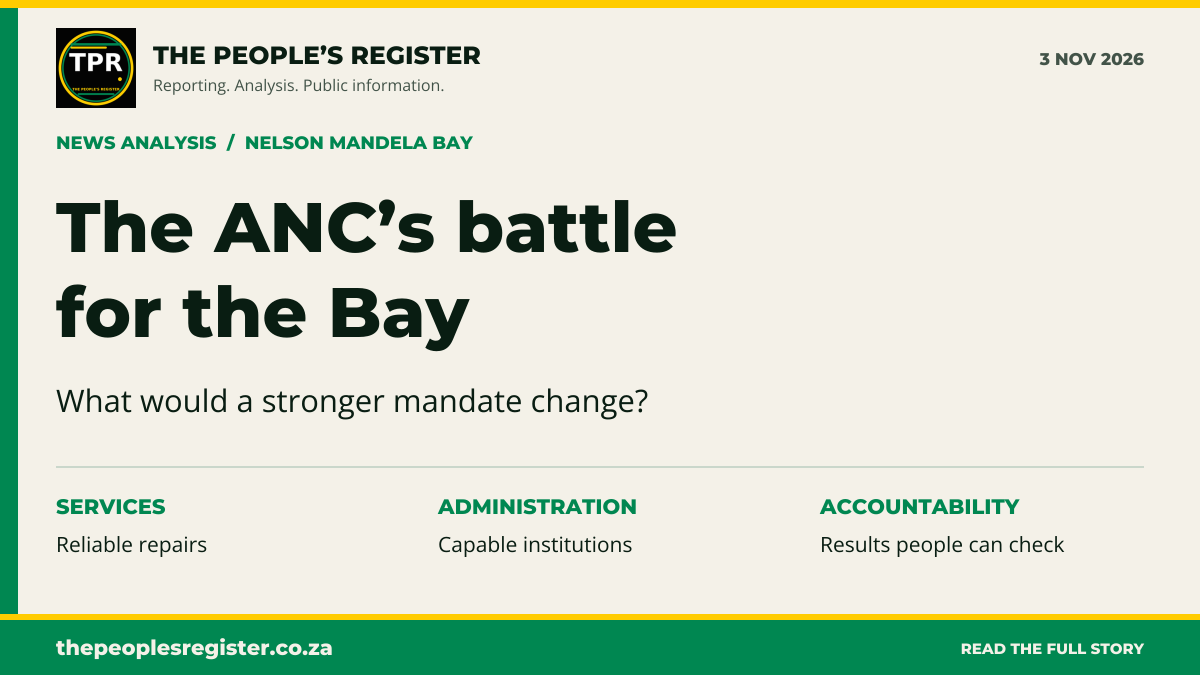
The ANC's bid for a stronger mandate in Nelson Mandela Bay is being fought over a practical question: can a more cohesive council turn decisions into reliable services, functioning administration and work?
At the Bay's election debate on 29 October, ANC national executive committee member Andile Lungisa argued that the municipality had performed better under an outright ANC administration. Daily Maverick's account of the debate, published on 1 November, records his criticism of the coalition period and the questions residents put to competing parties about infrastructure, appointments and municipal management.
The ANC enters this contest as the leader of the outgoing coalition. Its case therefore has to explain what a stronger mandate would change, how it would use that authority and how residents would judge the results.
The majority argument
The ANC's Nelson Mandela Bay regional manifesto supplied to TPR makes stability a central part of its appeal. It acknowledges continuing interruptions, slow repairs, ageing infrastructure and weaknesses in responding to complaints. It argues that more coherent authority would make implementation quicker and responsibility clearer.
That is a serious proposition to test. A council able to pass budgets and sustain a programme can give officials a clearer direction. The quality of appointments, maintenance, financial controls and public scrutiny will determine whether that direction becomes dependable delivery.
TPR's earlier report on coalition preferences examined the evidence about governing partnerships. The next stage is to compare any agreement after the election with the commitments parties made before it. An arrangement that distributes positions needs a published programme against which residents can hold its participants accountable.
A programme residents can interrogate
The regional manifesto proposes reporting water, sanitation and infrastructure work by project, ward and service outcome. It links implementation to a central project-management unit and reforms in the delivery of trading services.
That approach would make it possible to follow a repair beyond the announcement. Residents should be able to establish which project addresses a recurring problem, whether funding is available, who is responsible for the work and when the promised improvement will be tested.
For the local economy, the programme proposes a one-stop investment and enterprise service, faster and more predictable approvals, support for smaller enterprises and payment of compliant suppliers within 30 days. It also calls for public employment to build skills and routes into sustainable work.
These proposals connect the municipal machinery to livelihoods. A delayed supplier payment can leave a small business financing a public contract from money it needs for wages and materials. A repair backlog can disrupt the same business even after its application or payment is processed. The value of municipal coordination lies in resolving those connected pressures.
Capacity must accompany political authority
The debate report describes competing parties being challenged about leadership vacancies, professional appointments and interference in the administration. DA mayoral candidate Retief Odendaal argued that stability and protection for professionals were needed to attract suitable staff. Those questions will confront whichever parties form the next government.
The ANC's regional programme commits it to merit-based appointments in essential technical and management functions, stronger in-house capacity and action on procurement failures and audit findings. Those commitments give residents a basis for checking whether the organisation's promise of renewal changes how the municipality is managed.
Engineers need approved work, materials and competent supervision. Finance officials need accurate information and the ability to enforce controls. Workers need conditions that allow them to perform their tasks. Political leadership has to make those systems function together, while respecting the responsibilities attached to each position.
Keeping the mandate in public view
The ANC's proposed ward meetings, accessible councillor contacts, service-query references and regular scorecards could make the programme easier to scrutinise. Their usefulness will depend on whether a resident can trace an unresolved problem through the system and receive an answer that explains the action taken.
A stronger electoral mandate would give the ANC greater responsibility for demonstrating that these promises are practical. If the result produces shared government, its negotiations would need to explain how the same commitments survive the compromises involved.
Nelson Mandela Bay's election will settle representation. The governing test begins with the work that follows: a functioning administration, decisions that can be tracked and services whose reliability is felt beyond the council chamber.