
News · Elections 2026 · Security · Eastern Cape
Police report 59 arrests across voting days as results security continues
The Thursday NATJOINTS briefing separates 27 voting-day arrests from 32 during special voting. Eastern Cape figures are dated case records, not convictions or a finding on election outcomes.
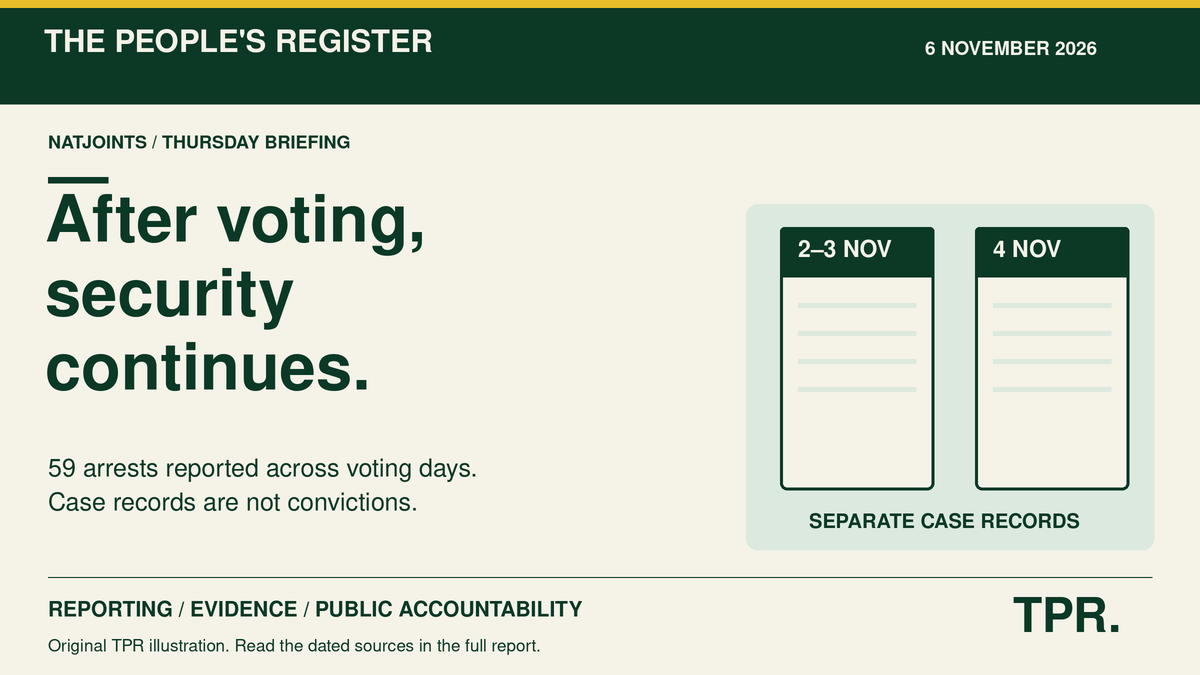
Law enforcement’s election operation did not end when voting finished. The dated NATJOINTS account puts 59 arrests across the two special-voting days and Election Day, while police continue protecting election materials and results operations.
Co-chairperson Lieutenant General Tebello Mosikili gave the figures at Thursday evening’s briefing, reported by SAnews on 5 November. They are the position in that briefing, not a new Friday total.
Two periods, separately recorded
For Wednesday, 4 November, police reported 85 incidents, 57 case dockets and 27 arrests. During special voting on Monday and Tuesday, they reported 65 criminal dockets and 32 arrests.
The two periods account for 122 dockets and 59 reported arrests. Incidents, dockets and arrests are different measures: one should not be substituted for another or presented as a count of proven offences.
The voting-day cases included alleged electoral-law contraventions alongside assault, intimidation, property damage, theft and other offences. Calling every docket a proven act of electoral fraud would misrepresent the briefing.
The Eastern Cape record
For the Eastern Cape, the briefing recorded ten cases and four arrests on Election Day, following eight cases and three arrests during special voting. These provincial figures do not establish that all the matters occurred in Nelson Mandela Bay, or identify the outcome of any individual investigation.
KwaZulu-Natal had the largest voting-day case figure in the provincial breakdown, at 15, followed by Limpopo with 11 and the Eastern Cape with ten. Those are recorded case counts in this operational account, rather than a measure of the validity of provincial results.
Security during the count
In the accompanying SAnews report, Mosikili said the continuing operation focused on protecting voting materials, securing results operations and safeguarding results management. NATJOINTS described voting as taking place without widespread disruption, while acknowledging incidents requiring intervention.
The same briefing reported action against a police member in KwaZulu-Natal who arrived at a station in a vehicle displaying political party branding. It did not provide a final disciplinary or criminal outcome. An allegation concerning an official must be tested with the same care as one concerning a voter or party agent.
Arrest begins a criminal process; it is not a conviction. The Constitution protects an accused person’s presumption of innocence. Whether an incident changes an election result is a separate question for the relevant electoral process and evidence.
For residents following the count, the useful records are the dated police update, the IEC’s response to any material objection and the actual result or declaration. A national arrest total does not answer who won a ward or which parties can form a council.
Read the evidence: SAnews reporting the NATJOINTS briefing, 5 November 2026 (opens in a new tab) · SAnews on security during results processing, 5 November 2026 (opens in a new tab) · Constitution, Chapter 2: fair-trial rights and presumption of innocence (opens in a new tab)
Sources, evidence and corrections
- SAnews reporting the NATJOINTS briefing, 5 November 2026 (opens in a new tab)
- SAnews on security during results processing, 5 November 2026 (opens in a new tab)
- Constitution, Chapter 2: fair-trial rights and presumption of innocence (opens in a new tab)
Sources reviewed on 6 November 2026. Read each source’s date, scope and the qualifications in the report.