
Called in for two hours? Check the four-hour minimum-pay rule
The 2026 wage floor is hourly, but a short shift can still attract four hours’ pay. Tips and transport allowances do not replace the wage.
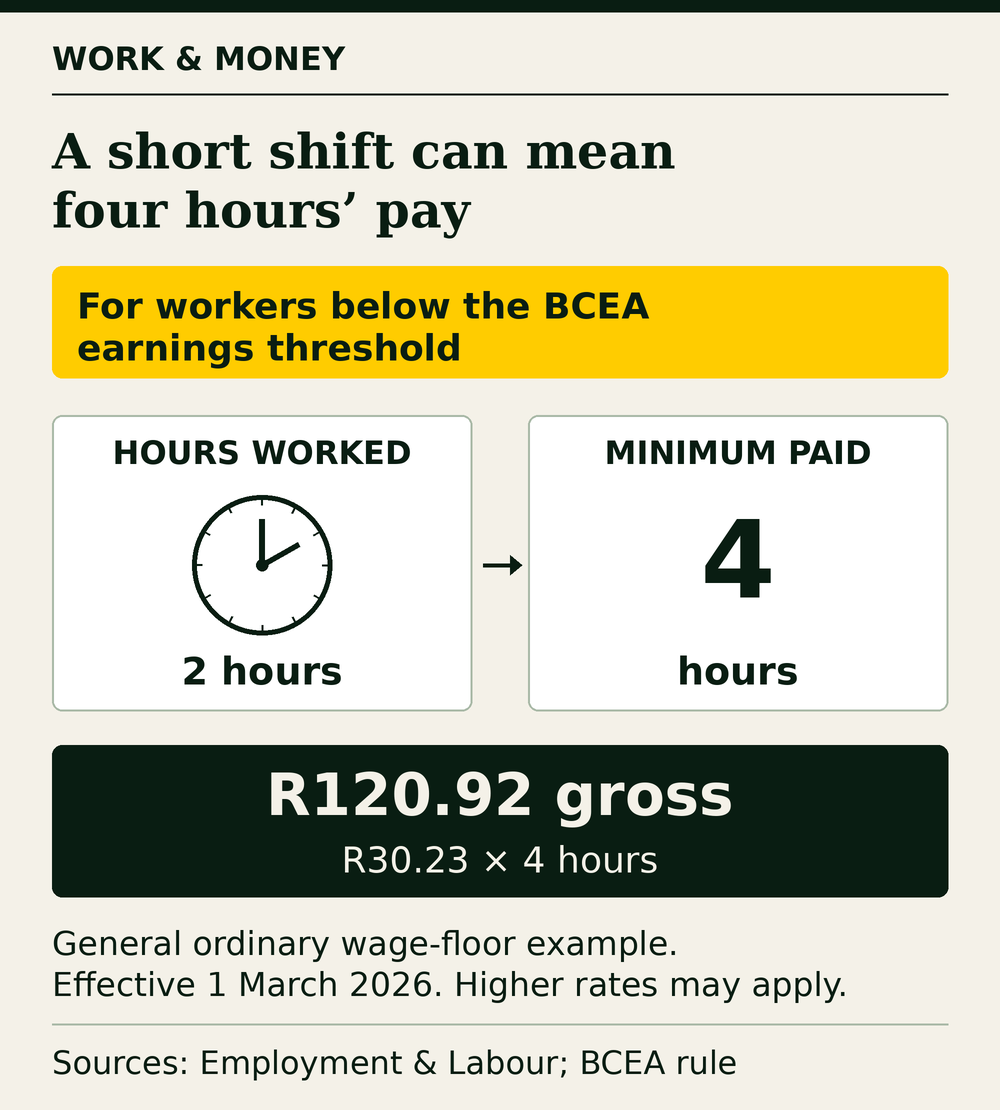
A two-hour shift can still attract four hours’ pay. The BCEA’s short-shift rule covers employees and workers earning below its earnings threshold. The department’s 2026 flyer summarises the four-hour minimum.
At the general national minimum of R30.23 an ordinary hour, that four-hour amount is R120.92. Eight ordinary hours at the same rate come to R241.84. These are gross wage-floor calculations, not estimates of take-home pay.
The general rate took effect on 1 March 2026 and includes farm and domestic workers. The gazetted schedule separately sets R16.62 an hour for the Expanded Public Works Programme and provides a separate allowance schedule for qualifying learnership agreements. An applicable higher wage remains important: the national figure is a floor, not a ceiling.
Keep the wage separate from the extras
Tips do not replace the minimum wage. Work-enabling allowances and payments in kind are also excluded from the calculation, unless a sectoral determination specifies otherwise. A promise of tips or a meal should not automatically be treated as the cash wage floor.
Keep your roster, actual hours and payslip together when checking a short shift. The department’s 2026 wage flyer (opens in a new tab) directs workers who are not paid the minimum to a labour centre or the CCMA. A sector or collective agreement may require more; this calculation does not settle every overtime or holiday-pay question.
Sources, evidence and corrections
- Employment and Labour: National Minimum Wage flyer, revised February2026 (opens in a new tab) · 2026-02
- Government Gazette54075, National Minimum Wage2026 (opens in a new tab) · 2026-02-03
- CCMA/BUSA: statutory obligations on employment (opens in a new tab)
- Department of Employment and Labour: minimum-wage calculation rules (opens in a new tab)