
Public Information · Elections 2026 · Corrections · Verification
When election figures change: how to check a corrected result
A changed IEC tally is not automatically fraud. Readers should compare the same station, ballot and timestamp and trace corrections through signed slips and official audits.
A screenshot of one party's vote total at 09:00 and another screenshot at 13:00 may look like evidence that votes disappeared or appeared. It is not enough to determine that conclusion.
South Africa's municipal counting process has several distinct stages. Voting-station results are recorded on slips, captured, scanned and independently audited. The Electoral Commission says its system applies double-blind capture and independent auditing to the results, rather than auditing only a sample. Checks and corrections are integral to this process.
What a credible comparison needs
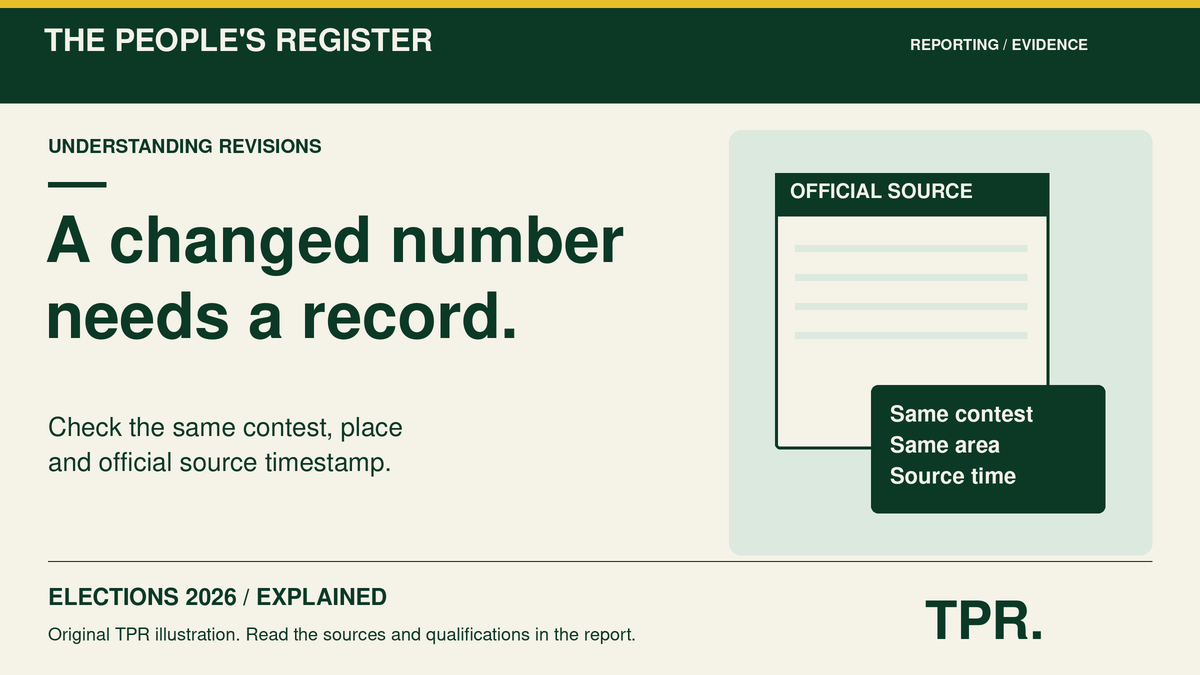
First, compare the exact same contest: ward, municipal proportional representation or district council. Second, compare the same municipality and voting-district boundaries. Third, note whether the earlier image covered partial reports and whether the later number incorporated more districts. Fourth, record the source timestamp and any published revision explanation.
Comparing different ballot types or different geographic coverage creates false discrepancies. A national vote aggregation cannot substitute for a single municipality's official council-seat calculation.
When a correction deserves scrutiny
A significant unexplained revision should prompt questions. Which underlying result slip changed? Was a duplicate capture removed? Did an audit reveal a transcription error? Did an objection or ruling require a revision? Is the corrected figure reflected consistently in the official source?
An unexplained mismatch should be investigated, not dismissed. But a difference between screenshots cannot, by itself, establish deliberate manipulation. That allegation requires evidence about the actual record and conduct.
How TPR will display revisions
Readers should see the current figure together with its retrieval time, official source, relevant completion status and correction history when available. Missing records should remain visibly missing, never silently rendered as zeros or guessed winners.
The purpose of a live results service is not to give an appearance of certainty. It is to let readers follow a verifiable count while preserving the documentary trail when information changes.
Reporting scope: A corrected tally does not, on its own, establish fraud. An unofficial party tally remains separate from an IEC declaration.
For the current official record, visit the Electoral Commission’s results service (opens in a new tab). TPR distinguishes recorded data, official declarations and unverified allegations.
Sources, evidence and corrections
- IEC counting, double capture and audit procedure (opens in a new tab)
- IEC 5 November objections, provisional results and revisions (opens in a new tab)
- IEC official results (opens in a new tab)
Evidence reviewed for publication on 5 November 2026. Source status and numerical results may subsequently change.