
News · Elections 2026 · Knysna · Coalition accountability
Knysna’s council arithmetic: DA nine seats, ANC four and no outright majority
The complete IEC dashboard allocation gives the DA nine of Knysna’s 21 seats. The ANC has four, the PA two and six other parties one each. A governing agreement is a separate record.
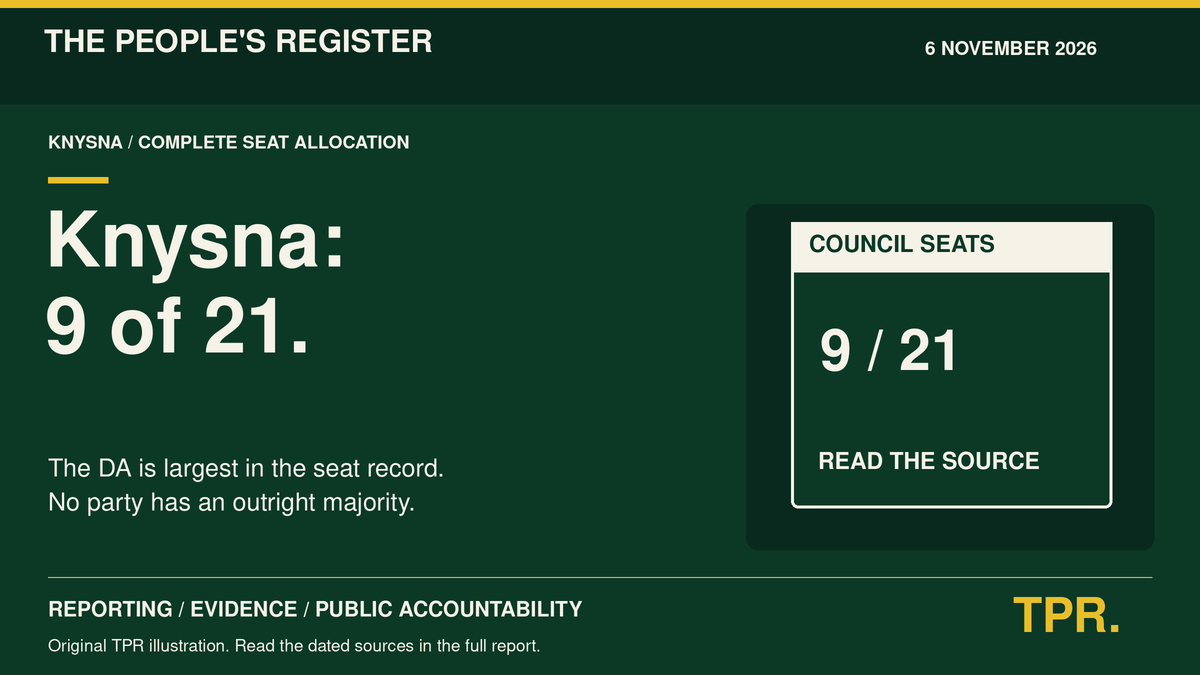
Knysna’s largest party does not have an outright council majority in the reviewed IEC record. The DA has nine of 21 seats, the ANC four and the Patriotic Alliance two. Six other parties have one seat each.
The source is the official municipal dashboard file dated 6 November 2026 at 17:37 SAST. It displays all 30 voting districts processed and all 21 council seats allocated. TPR checked the separate ward and municipal PR seat totals against that full council number.
How the 21 seats are distributed
| Party / IEC grouping | Ward | PR | Total |
|---|---|---|---|
| DA | 7 | 2 | 9 |
| ANC | 4 | 0 | 4 |
| PA | 0 | 2 | 2 |
| FF Plus | 0 | 1 | 1 |
| SACP | 0 | 1 | 1 |
| EFF | 0 | 1 | 1 |
| People'S Movement For Change | 0 | 1 | 1 |
| Knysna Civic Alliance | 0 | 1 | 1 |
| Choose Cx | 0 | 1 | 1 |
No party has an outright majority. Majority threshold: 11.
IEC source: 6 November 2026 at 17:37 SAST · Local results and station register
An outright majority of a 21-seat council is eleven. The DA’s nine are therefore two short. The ANC’s four make it the second-largest party in this allocation, with the PA on two. The six one-seat parties together account for the rest of the council.
That makes agreements and voting support important to the coming council. It does not prove that any particular combination has been negotiated, signed or accepted by its members. No coalition deal or mayoral appointment is established by this source.
Ward seats and PR seats do different work
The DA’s nine comprise seven ward seats and two municipal PR seats. The ANC’s four are ward seats, while the PA’s two are municipal PR seats. A ward contest and the council-wide PR allocation should not be treated as interchangeable victories.
The one-seat parties in the allocation are FF Plus, the SACP, the EFF, People’s Movement for Change, Knysna Civic Alliance and Choose CX. Those entries establish party or grouping seat totals; they do not identify the individual councillors who will take office.
What residents should ask of a governing arrangement
A useful agreement must tell residents more than who receives a position. It should identify responsibility for water, electricity, refuse collection, municipal finances and the public reporting of decisions. Those are accountability questions for every party seeking to govern.
A formal coalition is one possible arrangement; cooperation or voting agreements can take other forms. An outright-majority threshold describes the full council’s arithmetic. It should not be presented as a guarantee about the result of a particular council vote.
The IEC’s formal declaration and the council’s subsequent decisions remain separate records. TPR’s national tracker keeps this Knysna allocation beside other councils with no party majority, with dated source links rather than assumed partners or predicted winners.
Read the evidence: IEC Knysna record, 6 November 2026 at 17:37 SAST · Constitution, Chapter 7: municipal councils
Sources, evidence and corrections
Sources reviewed on 6 November 2026. Read each source’s date, scope and the qualifications in the report.