
News Analysis · Elections 2026 · ANC · Nelson Mandela Bay · Public accountability
Ramaphosa warns failing councillors: the accountability test for Nelson Mandela Bay
The ANC president’s 1 November warning gives the party’s local performance pledges renewed weight. In the Bay, public commitments will need dates, evidence and consistent consequences.
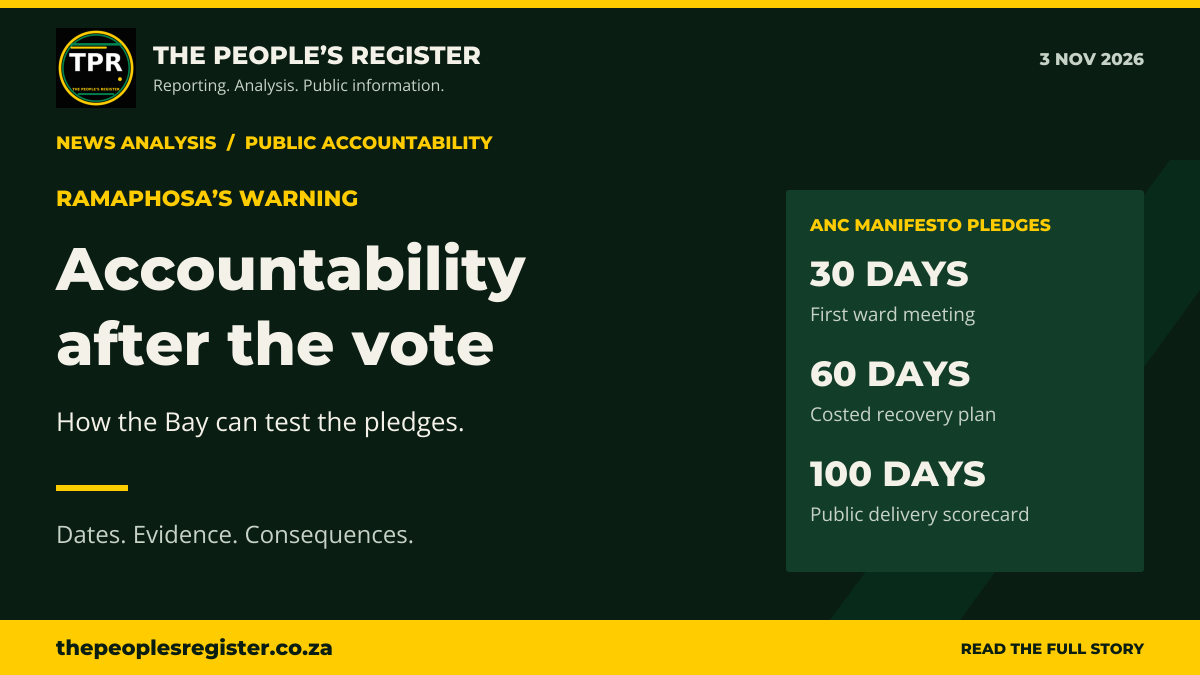
ANC president Cyril Ramaphosa's warning that councillors and mayors who fail communities could be removed puts a practical obligation alongside the party's appeal for another local government mandate: performance must be visible, and failure must have consequences.
At the party's closing Siyanqoba rally in Mdantsane on Sunday, 1 November, he said representatives were expected to use public money responsibly, maintain infrastructure and support economic development. Business Day's report of the address records his warning about representatives who fail to work for communities or misuse municipal funds: “we will take them out”.
SABC's account of the same rally also reports his commitment that ANC councillors would account to communities on their first 100 days in office. That offers a clearer measure than a general promise that leadership will improve.
What accountability would look like in the Bay
The regional manifesto supplied to TPR puts several commitments behind that pledge. It proposes public performance agreements and ethical-conduct pledges for ANC councillors, accessible contact details, ward meetings and regular reports on repairs and services.
Its opening programme calls for a first ward meeting within 30 days, a State of the Municipality report and costed recovery plan within 60 days, and a public delivery scorecard for the first 100 days. It also proposes an opening mayoral imbizo and a further account of progress before the programme concludes.
These are the ANC's stated commitments for the new term. Their implementation will require named responsibilities, public starting dates and programmes linked to the municipality's actual resources. An election result by itself does not supply that working timetable.
A resident should be able to find the promised meeting, read the programme agreed for the ward and compare the report-back with the work completed. If a commitment slips, the next account should give the reason, the responsible office and the revised completion date.
Consequences need a fair and public process
Ramaphosa's warning is a political undertaking by the ANC to act against failure among its representatives. Any action affecting public office must follow the applicable legal and organisational procedures. A rally declaration does not itself remove a councillor or change council arrangements.
Fairness also requires clarity about the problem being addressed. Deliberate misuse of public money, an official obstruction, a contractor's failure and a budget shortfall require different responses. Public reporting should establish what happened before responsibility is assigned, and should show what has been done to put the service right.
The ANC's published account of its August manifesto launch describes public performance agreements with targets and deadlines, local implementation plans and progress on urgent problems. Those mechanisms can help turn a leader's warning into a continuing obligation that residents can examine.
Measure the work, then act on the result
For a repair commitment, useful evidence would include the original fault report, the work assigned, the completion date and confirmation that the service is functioning. For a supplier-payment commitment, it would include verified invoice dates, payment dates and reasons for unresolved disputes.
The regional programme also proposes reference numbers and progress updates across service channels, alongside monthly ward reporting and quarterly delivery scorecards. Those records could expose repeat failures that disappear when each complaint is treated as an isolated incident.
This matters especially to households with little room to absorb the costs of unreliable services. Accountability has a material purpose: protecting the time, income and dignity of people who depend on public systems working. A scorecard earns its value when it helps secure a remedy.
TPR has already examined the water and audit record the next Bay council must address. The post-election reporting task is to follow the responsible institutions, track their commitments and establish whether promised corrections reach communities.
Ramaphosa has placed councillor performance at the centre of the ANC's final appeal. The next term will test whether the organisation publishes the evidence, hears residents when that evidence is disputed and acts consistently when its own representatives fall short.