
Ideas & History · African philosophy
Souleymane Bachir Diagne: a common humanity without an imperial centre
Diagne offers a demanding starting point for international solidarity: people should make a common world through exchange, rather than accept one civilisation’s claim to speak for everyone. Material inequality tests how far that promise can travel.

Share-image credit and reuse
Share card: the same photograph resized without cropping or retouching, with TPR headline and branding added. Photo adaptation: CC BY-SA 4.0 (opens in a new tab).
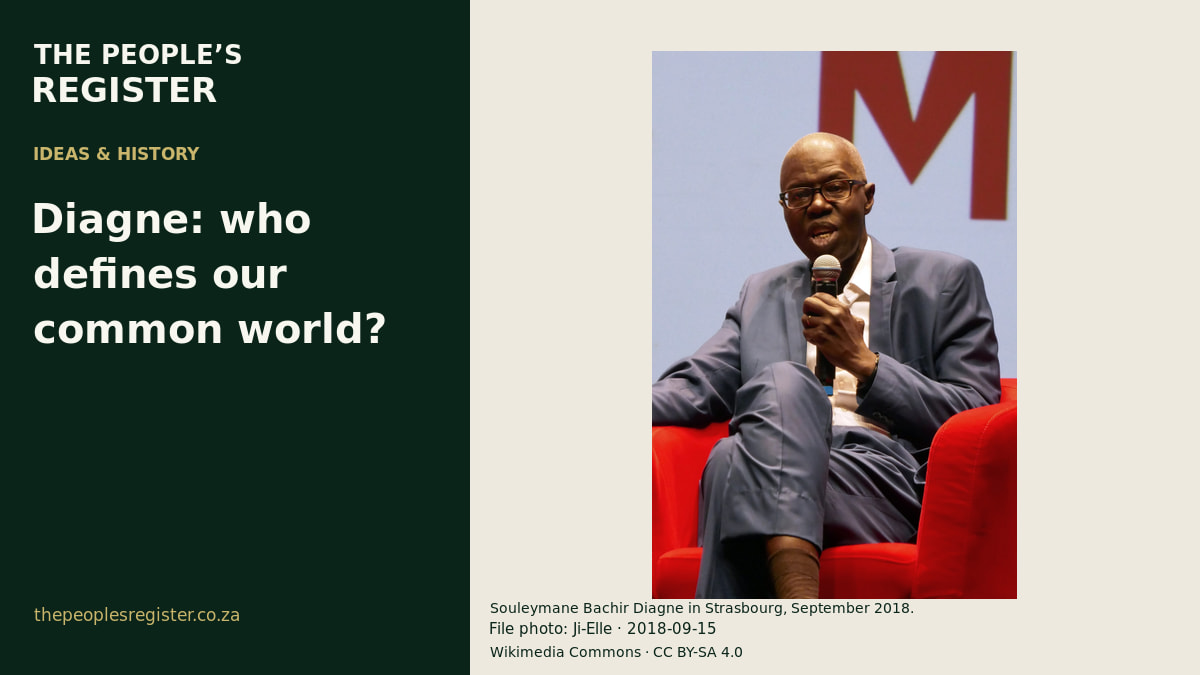
When one society calls its own experience universal, everyone else can be reduced to a local exception. Souleymane Bachir Diagne’s philosophy begins with a different possibility: humanity can construct something shared through the encounter between languages and traditions, without granting any one of them ownership of the whole.
The question has a timely setting. UNESCO’s announced World Philosophy Day programme (opens in a new tab) places Diagne at its Paris headquarters on 19 November for a lecture on living together on Earth, followed by a discussion with students. The programme connects philosophical reflection with challenges including climate change, migration, health and artificial intelligence.
Those subjects share a political difficulty: the people most affected by a common problem do not necessarily have equal power to define it. Diagne’s work helps identify that difficulty. It also invites a further question about the resources required to overcome it.
The thinker and the argument
Diagne was born in Saint-Louis, Senegal, and trained in philosophy in France before returning to teach at Cheikh Anta Diop University in Dakar. His Columbia profile (opens in a new tab) places his work across the history of logic, Islamic philosophy, African philosophy and literature. These are connected inquiries into how people reason and how thought moves between intellectual worlds.
In a 2025 Columbia interview (opens in a new tab), Diagne explains that rejecting the West’s claim to carry universal truth to everyone else need not mean abandoning a common humanity. He instead describes universalising as an activity: something people practise together.
Translation supplies his model. A language receives ideas made in another language without requiring either to become the sole language of reason. Drawing on Maurice Merleau-Ponty, Diagne contrasts a universal imposed from above with one developed across cultures on a shared plane. The point is a continuing relationship, rather than a finished doctrine delivered by a privileged centre.
His argument therefore places responsibility on the encounter itself. Listening cannot mean simply waiting for the other speaker to adopt your vocabulary. It asks whether your own categories can be changed by what the other person says.
What the history adds
In its account of his 2021 inaugural lecture (opens in a new tab), Sciences Po describes how Diagne used the 1955 Bandung conference to discuss the entry of formerly colonised societies into a world long organised around a European centre. He linked that political plurality to a philosophical task: rebuilding the universal through negotiation.
The account also records his engagement with Aimé Césaire’s warning against both confinement within a particular identity and disappearance into an abstract universal. Diagne’s response resists sealed cultural borders. Translation remains unfinished because people can return to a difficult meaning and try again.
This gives anti-imperial solidarity a constructive demand. Challenging domination should enlarge the space in which peoples can think and act together. Cultural dignity does not require surrendering the possibility of criticism across borders, or treating every practice as beyond discussion because it belongs to a particular tradition.
The difficult question is power
There is a strong objection to making translation the central political image: people can understand one another and still possess radically unequal bargaining power. A worker may explain a grievance perfectly while lacking the money to sustain a strike. A small country may make an internationally intelligible demand while remaining dependent on a creditor.
These are illustrative tests of the argument, not examples Diagne supplies in the interview. They show why a shared conversation cannot by itself redistribute property, finance or institutional authority. The ability to speak and the ability to change a decision are related, but distinct.
A material reading of Diagne should therefore ask who pays for interpretation, research, travel and sustained participation; whose language is treated as the default; and who controls the institution that turns a discussion into a binding outcome. Equal invitations can coexist with unequal capacity to use them.
The strongest response is to make his proposed equality a standard against which institutions are judged. If participants are meant to meet on a common plane, then arrangements that make some voices permanently dependent demand change. Translation can expose the inequality even when it cannot supply the entire programme for ending it.
A useful demand on public life
For a multilingual democracy, the implication is practical. Public information should reach people in forms they can use, and participation should allow their knowledge to reshape the decision. Translating an announcement after the important choices have already been made falls short of that ambition.
For Pan-African thought, the same principle makes solidarity an active intellectual relationship. Africa contains many languages, histories and political experiences. Building shared purpose requires taking those differences seriously while testing proposals against common needs such as dignity, democratic control and access to the means of living.
Diagne’s contribution is to keep that work open. No civilisation has a permanent right to define humanity for the rest. A common world must be made with the people who inhabit it, and the measure of the effort is whether they gain a meaningful part in shaping its terms.