
Public Information · Elections 2026 · Special votes · Fact check
Why IEC special votes use two envelopes, and how ballot secrecy works
A voter's details on an outer envelope do not identify the marked ballot: the IEC's two-envelope procedure separates eligibility checks from the secret vote.
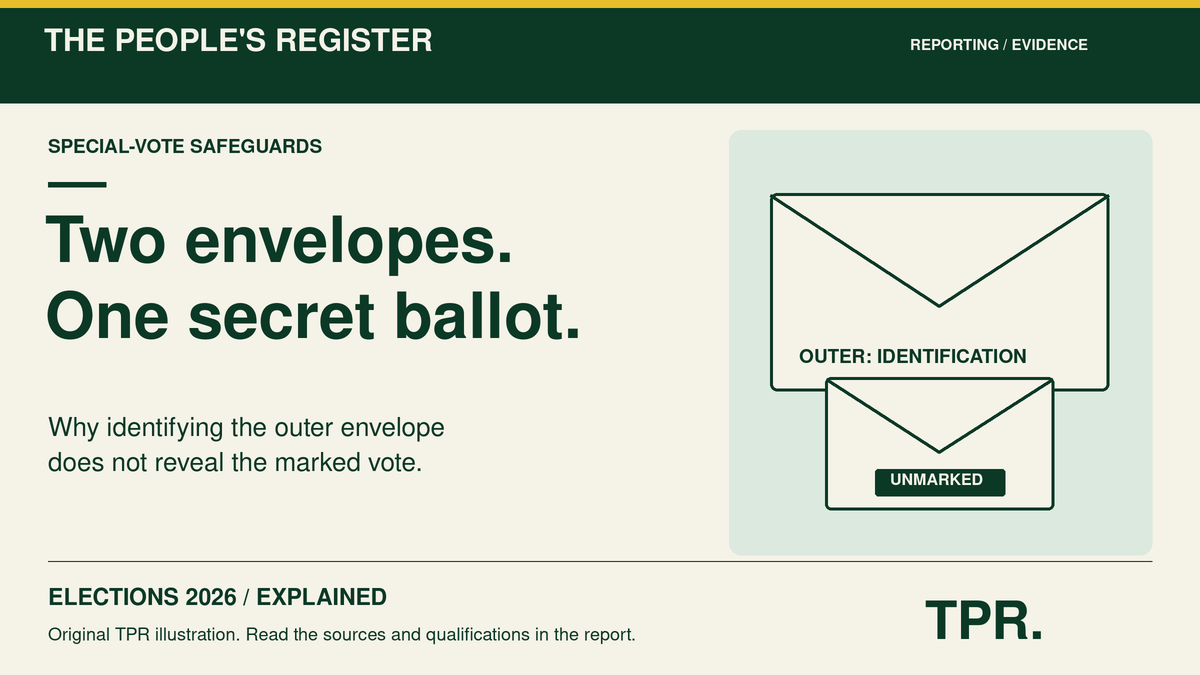
Videos and photographs of election materials can become evidence of genuine problems, but they can also travel without the procedures that explain what is shown. One recurring concern is an envelope bearing a person's details. Does that mean election officials can read how that individual voted?
The Electoral Commission's published special-vote procedure provides the answer to the normal, lawful process. A successful special voter marks the ballot in secret and seals it in an unmarked inner envelope. That inner envelope goes into a second envelope bearing the voter's name, identity number and voting-district number. The outer envelope is used to administer and reconcile the special vote. It is discarded before counting to protect ballot secrecy.
The presence of identifying information on the outer envelope is therefore not, on its own, evidence that a marked ballot has been linked to a named person. Equally, the existence of the procedure does not prove that every envelope shown in circulating footage was processed properly. Specific allegations require inspection of the original material and the IEC's response.
Who could cast a special vote?
Approved special votes included station-based voters unable to attend on Election Day and home visits for eligible voters unable to travel because of their physical condition. The Commission reported approving 2,655,067 special-vote applications ahead of the election: 678,525 home-visit applications and 1,976,542 station-based applications as of its October readiness briefing. Applications approved do not equal ballots actually cast.
Special voting took place on 2 and 3 November, before the ordinary 4 November election. Anyone comparing preliminary participation figures must keep applications, voters who participated and counted ballots separate.
What to check before passing on a claim
Ask what stage of the process the video shows, whether the envelope is inner or outer, which voting district it concerns, whether the footage has a verified date and what the Commission says about that particular incident.
An image of a named outer envelope cannot alone demonstrate a breach of secrecy. A properly supported allegation that the inner envelope was opened while still linked to identifying details would raise a different question requiring investigation.
Election integrity depends on the public being able to understand the safeguards and scrutinise possible breaches without turning ordinary procedure into an accusation.
Reporting scope: This describes normal IEC procedure, not proof that every image or video circulating online depicts a compliant instance.
For the current official record, visit the Electoral Commission’s results service (opens in a new tab). TPR distinguishes recorded data, official declarations and unverified allegations.
Sources, evidence and corrections
- IEC: official special-vote procedure (opens in a new tab)
- IEC: special-vote applications and preparations (opens in a new tab)
- IEC: participation in special voting, 3 November (opens in a new tab)
Evidence reviewed for publication on 5 November 2026. Source status and numerical results may subsequently change.