
Africa & world · US technology outages and infrastructure resilience
America’s outage week: what the evidence says about cyberattack claims
A cluster of failures deserves scrutiny. The available records identify maintenance problems and software faults, while leaving questions about how essential systems withstand disruption.

Share-image credit and reuse
Share card: the same photograph resized without cropping or retouching, with TPR headline and branding added. Source photograph: Public domain (opens in a new tab).
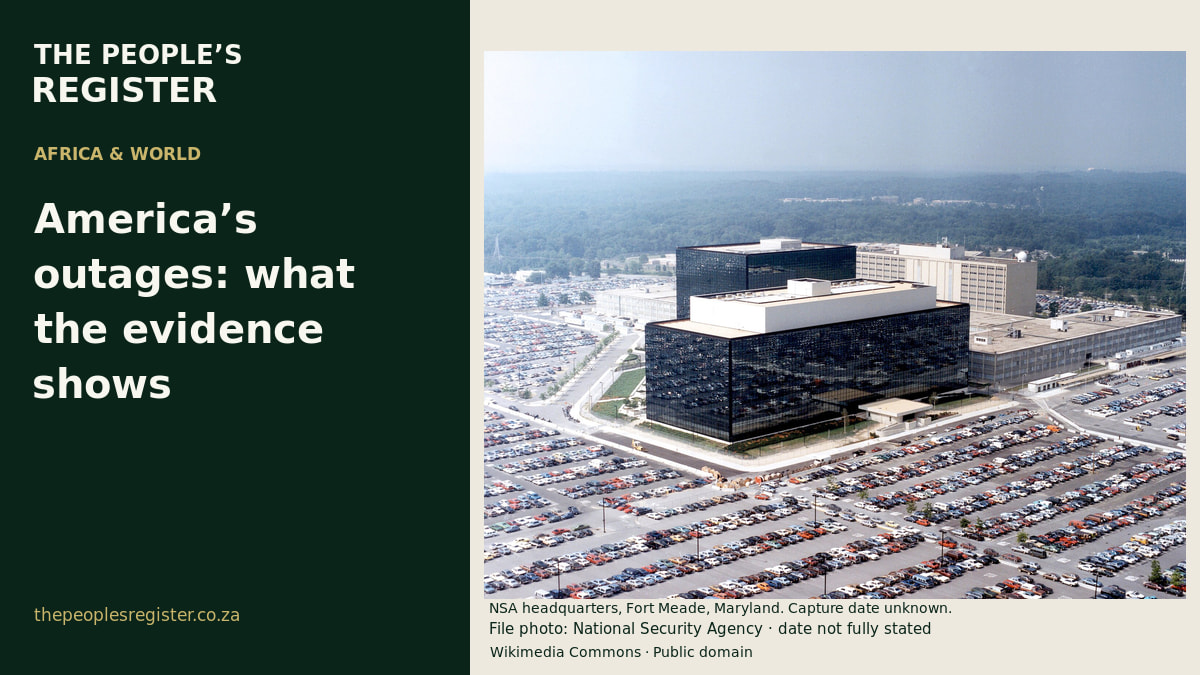
Apple, Microsoft, the Federal Aviation Administration and the National Security Agency have reported outages or degraded services within a week. Their accounts point to technical problems, with varying levels of detail. No coordinated cyberattack linking the four incidents has been established.
The failures still raise questions about how major institutions keep services running through faults and maintenance. An email system, an air-traffic network and an intelligence agency perform different functions, but each depends on safeguards that can contain disruption and support recovery.
What each operator has actually said
On 17 November, the National Security Agency said (opens in a new tab) some internal systems had experienced degraded performance during scheduled maintenance. It said critical capabilities remained operational and described multiple layers of redundancy. The short statement does not give a detailed technical cause, the number of affected users or a full restoration timeline. It therefore supports a narrower account than the claim that the entire agency was knocked offline.
Apple attributed Tuesday’s disruption to an internal update and ruled out a cyberattack in a statement reported by Reuters (opens in a new tab). Services affected included iCloud and Apple Pay. The company said many systems were operating again while restoration continued. That is the company’s account of its own incident; it does not explain the other outages.
The Federal Aviation Administration’s account (opens in a new tab) is more detailed. It says network instability on 13 November prompted a nationwide ground stop. Excessive connection attempts disrupted older equipment, with investigators initially focusing on sites in Amarillo, Texas, and El Dorado, Arkansas. A new router had been installed at the Arkansas site. Blocking the two locations helped stabilise the network.
The FAA says there was no indication of a cyberattack or an outside malicious actor. Some radio frequencies and radar feeds continued operating, and aircraft already airborne landed safely. The account describes a serious degradation of service, rather than the complete loss of every means of communicating with aircraft.
Microsoft’s incident notices, preserved by the University of Pennsylvania (opens in a new tab), describe a different failure. During network maintenance and upgrades, traffic changes exposed a dormant software bug. Requests accumulated until affected servers ran out of processing capacity and could no longer accept new connections. The notices identify the disruption as technical and unrelated to cyberattack or AI agents.
For incident MO1550821, Microsoft records the main impact from 16:20 UTC on 12 November until 16:10 UTC on 13 November, almost 24 hours. Its account also explains why several products appeared to fail together: functions in those products depended on Exchange Online. Services sharing a broken dependency can produce multiple visible outages from one underlying incident.
A crowded timeline is not a technical link
These explanations should be tested against the evidence as investigations progress. They should not be discarded simply because the incidents occurred close together. To link the failures, investigators would need evidence of a shared component, a common change, an intrusion or some other causal relationship. The statements reviewed here do not supply that connection.
The language used in early reports can also mislead. A network overwhelmed by requests is not, by that description alone, proof of a deliberate denial-of-service attack. In Microsoft’s account, queued requests and reduced capacity were consequences of a software problem. In the FAA account, investigators were examining network behaviour and equipment. Similar symptoms do not settle what caused them.
The UK’s National Cyber Security Centre guidance (opens in a new tab) explains the work required to establish an incident’s cause: examine network traffic, account activity, system records and other evidence, then correlate those records. It also stresses that logs need consistent timestamps and must actually be retrievable. An organisation’s confidence is more persuasive when it can be supported by that kind of record.
South Africa has a direct stake
This is not solely an American service problem. SARS issued a notice on 13 November (opens in a new tab) warning that Microsoft’s global outage could affect access to Outlook, Teams and other Microsoft 365 applications. The notice said its technical teams were engaging Microsoft. SARS did not report an eFiling failure in that notice.
When a communication platform fails, an organisation needs other ways for staff to contact one another, route urgent requests and access essential records securely. Those arrangements matter whether the initial fault is malicious or accidental.
The next evidence to demand
The US National Institute of Standards and Technology’s current incident-response guidance (opens in a new tab) places preparation, detection, response and recovery inside everyday risk management. Recovering a service is only part of the work; organisations also need to reduce the impact of the next incident.
In Britain, the government told Parliament on 16 November (opens in a new tab) that the Microsoft disruption affected businesses and public services, while critical services remained available. It said it would seek lessons from Microsoft on prevention and faster recovery. A detailed account of the faults and the changes made afterwards would show whether the weaknesses behind the disruption have been addressed.
The available accounts describe technical failures, with uneven detail about their causes. They do not identify a common attacker or a coordinated campaign. Fuller incident reports are needed to explain the impact, the limits of existing safeguards and the changes intended to prevent a repeat.
Sources, evidence and corrections
- NSA statement on network issues (opens in a new tab)
- Reuters: Apple attributes outage to an internal update (opens in a new tab)
- FAA: Nationwide Ground Stop, Questions and Answers (opens in a new tab)
- Microsoft incident MO1550821 notices preserved by the University of Pennsylvania (opens in a new tab)
- UK National Cyber Security Centre: incident evidence and technical response (opens in a new tab)
- SARS notice on the Microsoft global outage (opens in a new tab)
- NIST SP 800-61 Revision 3: incident response recommendations (opens in a new tab)
- UK House of Commons: statement on Microsoft 365 outage (opens in a new tab)