
Africa & world · Public procurement and veterans benefits
US veterans fraud crackdown exposes failed Florida cancer-centre contract
The announcement covers different legal stages. New allegations must be distinguished from convictions and intended losses from money actually paid.

Share-image credit and reuse
Share card: the same photograph resized without cropping or retouching, with TPR headline and branding added. Photo adaptation: CC BY-SA 3.0 (opens in a new tab).
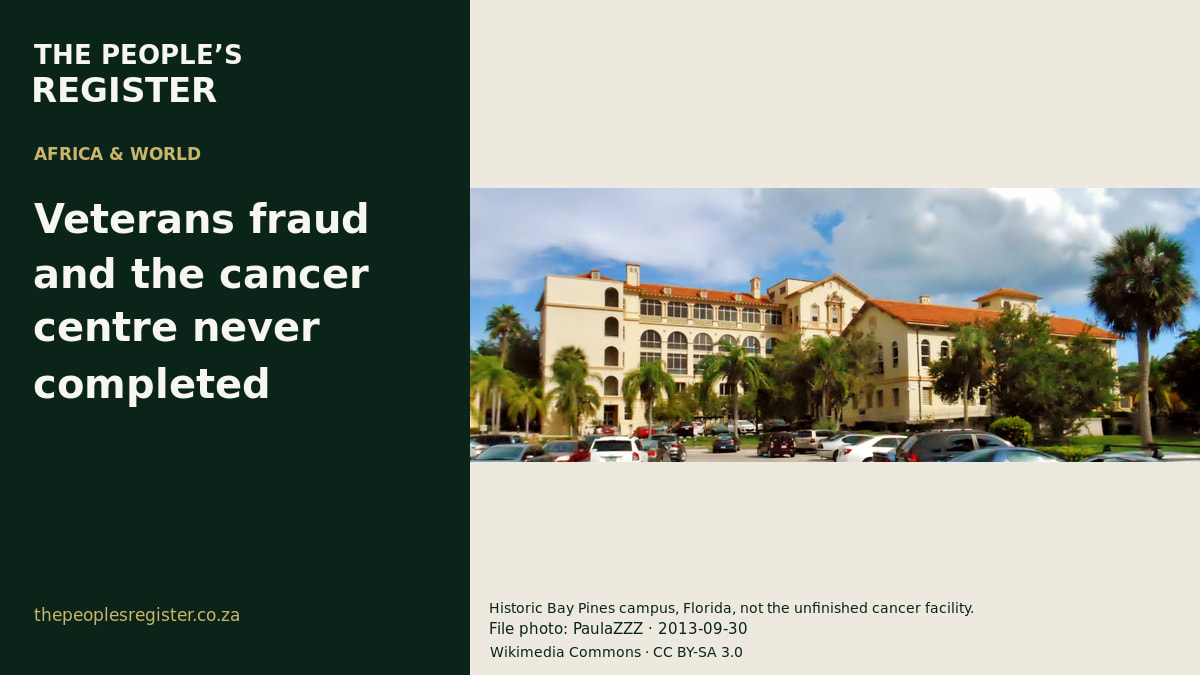
A cancer treatment building that was partly constructed and then demolished is among the cases highlighted in a US veterans-benefits enforcement announcement, exposing a stark gap between money paid and a public service delivered. The Florida prosecutors’ account (opens in a new tab) says about US$4.8 million was paid under the contract, but the proposed facility was never rebuilt.
The national Justice Department announcement on 17 November (opens in a new tab) covers action from 1 September. It reports charges against 15 defendants involving more than US$3.4 million in intended losses. Separately, it lists guilty pleas, trial verdicts and sentencings involving more than US$19 million in intended losses. The latter figure is not the amount allegedly stolen by the 15 newly charged people.
The contract behind the empty promise
The Bay Pines Cancer Infusion Therapy Center contract, worth about US$8.93 million, was reserved for businesses owned by service-disabled veterans. Prosecutors say trial evidence showed concealed arrangements under which an ineligible company would manage most of the work and receive most of the payments.
A jury convicted Matthew West and Kevin Kutina of conspiracy, wire fraud and major fraud against the United States. Robert and William Gonzalez had previously pleaded guilty to conspiracy. West and Kutina’s sentencing hearings are scheduled for 4 February 2027. Both men have been convicted and are awaiting sentence.
Benefits can be diverted at several points
The national announcement also includes a case involving a former benefits fiduciary, Barbara Ferrell, who admitted taking approximately US$114,661 meant for a family member. Other highlighted cases concern disability payments and education benefits. The range illustrates why the phrase “veterans fraud” can cover very different conduct, from diverting an individual’s money to misrepresenting who will perform a public contract.
An accusation remains an accusation where a case has not produced a guilty plea or verdict. The Justice Department itself records that people charged are presumed innocent unless proved guilty. Its enforcement totals also use intended loss, which should not be treated automatically as money actually paid out.
The procurement lesson is concrete. A preference intended to direct opportunity towards a particular group depends on checking who controls the work, who gets paid and whether the promised service is completed. A qualifying name on a bid does not answer those questions. In the Bay Pines case, the failed building gives the financial wrongdoing a second dimension: public spending did not produce the additional treatment space it was meant to provide.